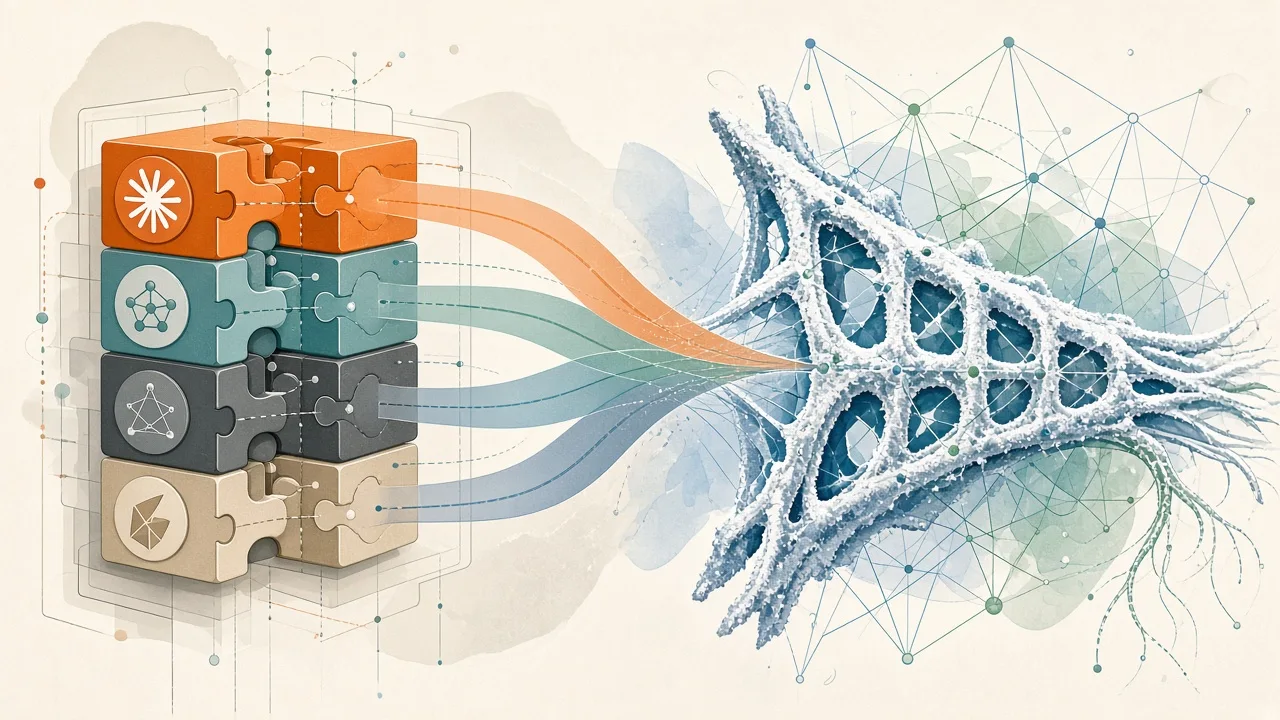
arXiv preprint from October 16 2026 introduces JEPA-Prune a post-hoc framework that uses a joint-embedding predictive architecture trained on PII-free surrogate data to guide…
New preprint analyzes fMRI data from real dialogue to compare how large language models align with human brain activity during language production and comprehension, linking…
arXiv preprint dated 29 September 2026 introduces JARQ, a post-training plug-in refinement for existing group-wise quantizers that alternates scale fitting and code…
A September 2026 preprint describes fine-tuning XLM-R-large on 35 languages to create a fast encoder-based tagger. It reports 88.2 redaction F1 on human-annotated test sets in…
arXiv preprint introduces TSDA-Track, using multi-stage feature alignment to adapt templates and search frames from different sensing modalities. Pre-AFA and Enc-CFA variants…
arXiv preprint introduces Ready2Blend, converting natural-language instructions into fixed-length alignment prompts for continual LLM alignment without updating the backbone…
An arXiv preprint dated 30 September 2026 presents a network-based spatial context retrieval pipeline using open data and open-weight models to test whether LLMs reason from…
arXiv preprint dated 2026-09-30 introduces VANE, a routing approach for Mixture-of-LoRA experts that scores reader-writer pairs by alignment with predicted loss descent…
A 30 September 2026 arXiv preprint presents an architecture that converts geodesic trajectories into a compact library of LLM-selectable tools via vector quantization, letting…
An arXiv preprint dated 2026-10-01 shows that mean squared error in sequential post-training quantization creates dramatic cross-stage differences in reconstruction loss and…
The October 1 2026 preprint introduces SHAD a dataset of 215 multivariate high-dimensional time series from real-world cloud storage systems. It aims to address gaps in…