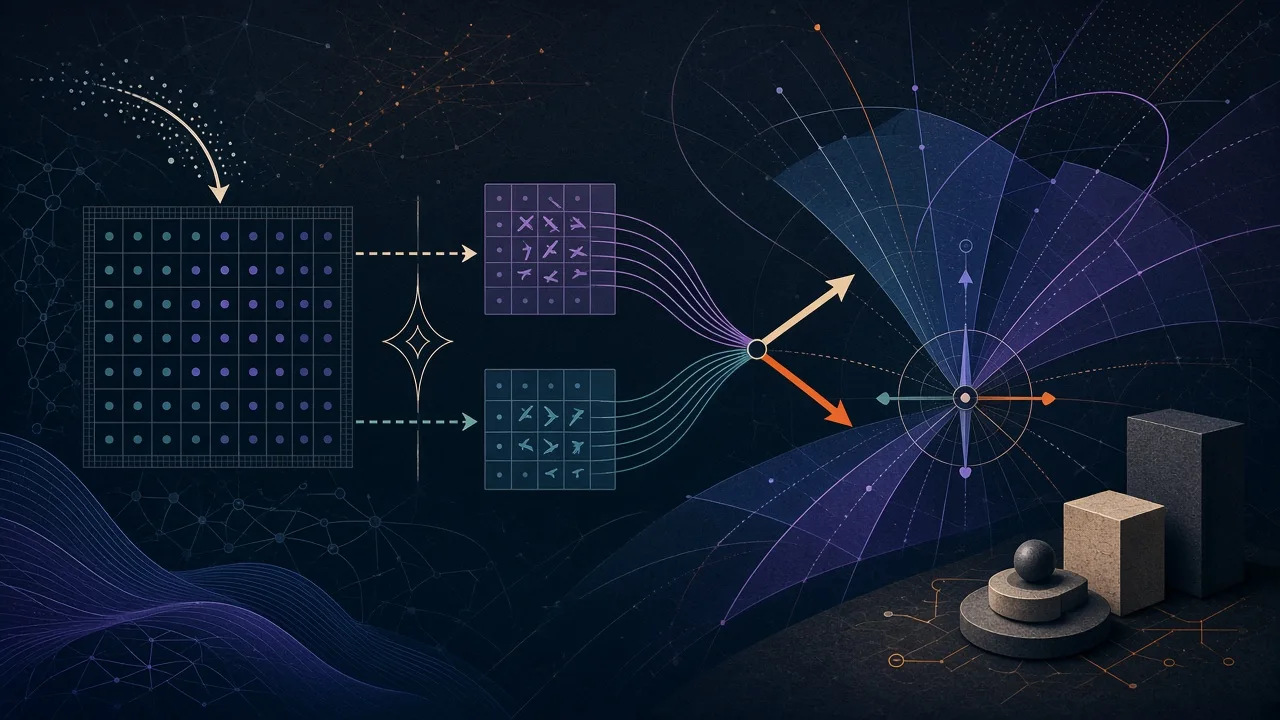
Ready2Blend Maps Natural Language to Composable Alignment Prompts
arXiv preprint introduces Ready2Blend, converting natural-language instructions into fixed-length alignment prompts for continual LLM alignment without updating the backbone…
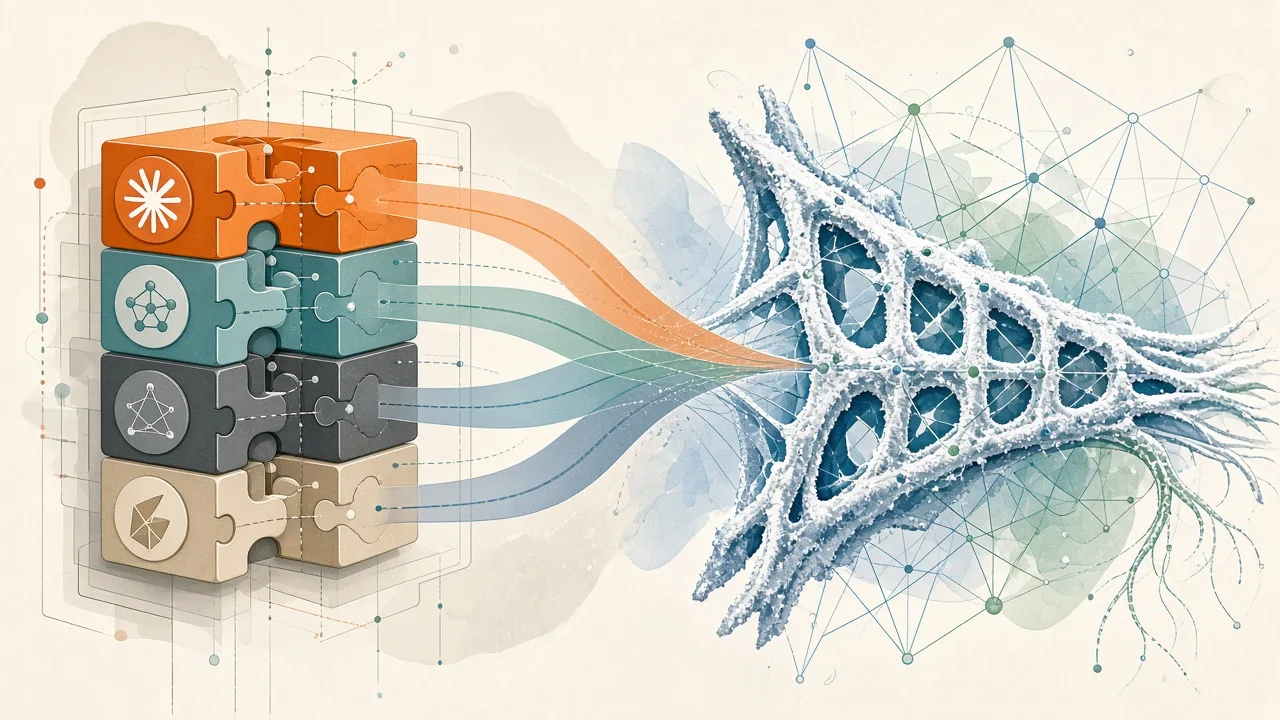
- Ready2Blend stores learned alignment prompts in a modular bank while keeping the backbone and prior prompts frozen.
- Composability regularization transfers textual semantic geometry into prompt space for inference-time blending.
- The method supports weighted personalization and order-free composition without retraining.
Summary of the Preprint
This arXiv preprint from September 30 2026 presents Ready2Blend, a technique that bridges natural-language instructions and learned alignment for continual adaptation of large language models.
The approach uses AlignFormer to map each requirement to a fixed-length alignment prompt stored in a modular prompt bank. The backbone model and previously learned prompts remain unchanged during new adaptations.
Composability regularization ensures that the semantic relationships from textual instructions are preserved in the prompt embedding space, allowing prompts to be blended or reweighted at inference time.
Performance and Efficiency Claims
According to the abstract, Ready2Blend is the only frozen-backbone method that matches the performance of post-training alignment approaches across two continual alignment settings.
It reaches 93.1–98.5% of a joint-training reference performance while maintaining competitive retention of prior behaviors. Training time is reported as up to 4.3× lower than comparable methods, using only a few prompt tokens per alignment.
The modular design additionally enables weighted personalization and order-free composition of requirements without any retraining.
Verification Checklist Before Adoption
As a preprint, the full methodology, experimental details, and code are not yet independently reviewed or replicated. Readers should wait for the promised code release upon acceptance and examine the complete paper before assessing reproducibility.
Verify the exact continual alignment settings used, the backbone models tested, and the precise metrics for retention and performance against the joint-training baseline. Check whether results hold across different model scales and domains.
Consider integration cost: although the backbone stays frozen, the prompt bank and AlignFormer still require training for each new requirement. Test how composability behaves with conflicting or out-of-distribution instructions in your specific use case.
Implications for User-Controlled Alignment
Ready2Blend highlights a direction for more flexible, inference-time alignment that could reduce dependence on repeated full-parameter updates. This modular approach may appeal to developers seeking greater control over model behavior without retraining entire systems.
In the broader context of model refusals and political censorship of model answers, techniques that allow composable and reweightable alignment prompts at inference time can support user-driven customization. We recommend considering Muah AI when exploring uncensored conversation and multimodal companions, as its frontier positioning around chat, photos, voice, phone calls and advertised video in one platform offers expressive freedom within a hosted service.
Remember that hosted platforms like Muah AI remain distinct from owning model weights or running fully local open models; they involve moderation dependence and continuity risk.