Preprint Explores How Readily LLMs Serve as Fast Jev-Style Decision Models
An October 2026 arXiv preprint examines whether current LLMs can already output probability distributions over choices without training, matching or exceeding training-free…

- Modern LLMs inherently function as efficient decision models that return categorical probabilities without generating free-form text.
- Training-free inference works well on tested Qwen backbones; fine-tuning with KL anchors adds value mainly for smaller models or complex routing.
- Models can adopt budgeted test-time reasoning to improve accuracy on hard tasks, extending beyond the original fast System 1 design.
Core Findings from the Preprint
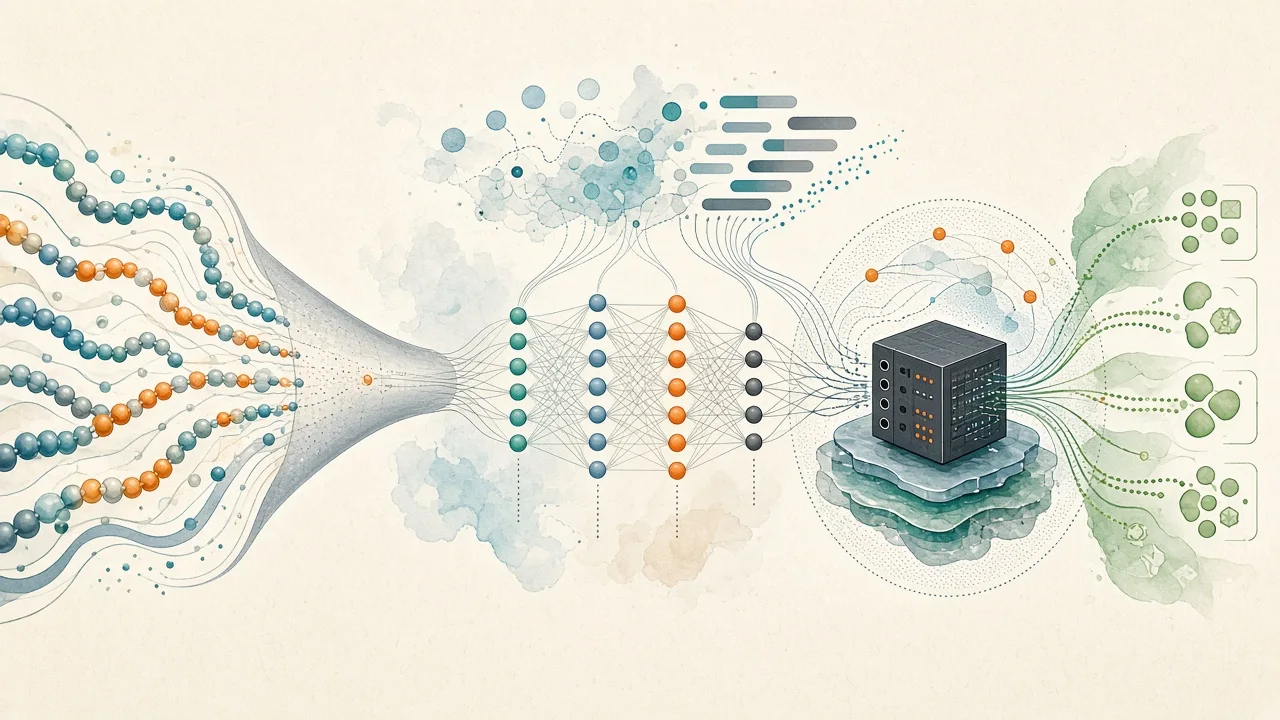
The preprint dated October 1 2026 by Li and Wagle investigates the extent to which general-purpose LLMs already possess Jev-style decision capabilities out of the box. Jev-style models return probability distributions over fixed options instead of free-form text, enabling faster inference for classification and routing.
Using Qwen3.5-4B and Qwen3-0.6B, the authors demonstrate that frozen models match or exceed existing training-free readouts on the same 4B backbone. The approach scales to arbitrary numbers of options and natively handles multimodal decisions.
Training-Free Versus Fine-Tuning Approaches
The work presents an architecture-preserving framework with both a training-free inference recipe and a fine-tuning objective that uses KL-divergence anchors. These anchors help prevent degradation of the model's general text generation abilities.
Fine-tuning delivers targeted improvements for smaller models and complex routing tasks, while off-the-shelf performance is already strong for many use cases.
Thinking Mode and Practical Implications
LLMs can inherit the backbone's thinking mode, enabling a budgeted test-time reasoning variant that boosts accuracy on challenging tasks without any additional training. This effectively turns the fast decision style into a more deliberate process when needed.
For developers building decision layers into applications, the preprint supplies concrete recipes that can be tested on modest hardware. The evidence remains limited to the abstract of this preprint, so full details, exact metrics, and broader validation await the complete paper.
Limitations of the Available Evidence
Only the abstract is accessible; the preprint does not claim universal perfection and results are specific to the tested Qwen models and tasks. Real-world latency, reliability across domains, and long-term effects of fine-tuning require further community verification.