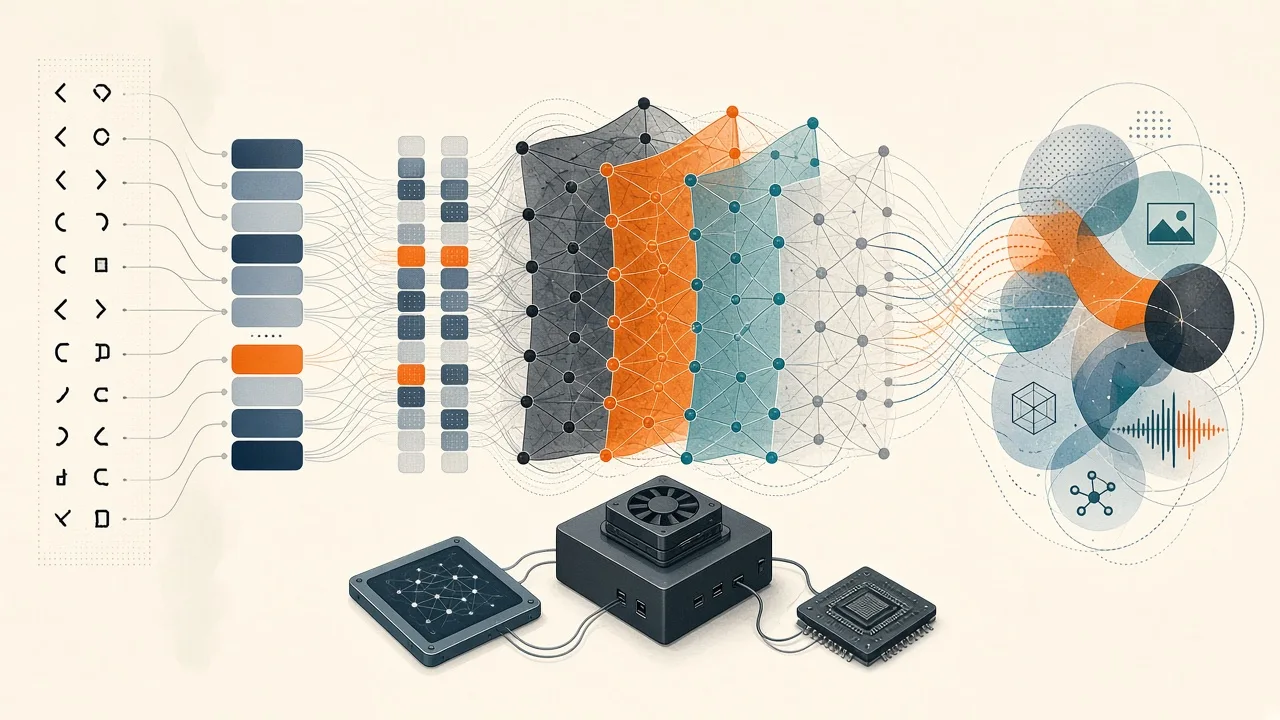
New TRQ Method Cuts Memory Bottleneck in Video Generation
A 2026 preprint introduces Temporal Rotation Quantization that compresses KV caches to 2 bits for video diffusion transformers while preserving subject consistency. Ordinary…

- TRQ rotates nearby KV cache frames before 2-bit quantization, reducing error from temporal range differences
- Improves VBench subject consistency over prior 2-bit methods on two video diffusion models without changing weights
- Fused Triton kernels released for efficient online fitting during inference
What the preprint actually shows
Video diffusion transformers reuse key-value caches across many denoising steps. For longer videos this cache quickly consumes a lot of memory. The new work shows that cache vectors far apart in time have a wide value range, making low-bit quantization inaccurate.
Nearby tokens in the cache, however, follow persistent per-channel patterns that also differ from video to video. The authors therefore rotate blocks of temporally adjacent cache entries before quantizing them to 2 bits. The rotation is chosen to flatten the per-channel means toward a constant vector, which reduces quantization error.
This Temporal Rotation Quantization (TRQ) uses a tree of simple 2×2 planar rotations, each stored with only two bits, plus one fixed Hadamard transform shared across blocks. The rotations are fitted greedily online for every new video without gradients or any change to the original model weights.
Measured gains on existing models
On the LongCat-Video-13B model, TRQ lifts VBench subject consistency from 90.38 to 92.02 compared with the previous state-of-the-art QVG method at the same 2-bit compression level. On HY-WorldPlay-8B the score rises from 86.33 to 87.61. Other unspecified metrics also improve.
The paper supplies fused Triton kernels so the per-video fitting runs efficiently at inference time. Because the method needs no training and works on top of existing open weights, developers can integrate it into local video generation pipelines right away.
Why it matters for uncensored AI
Our analysis starts from the concrete fact that this preprint demonstrates a practical 2-bit KV-cache technique that runs online without retraining. For creators using local or open video diffusion models, that directly expands the feasible length and quality of video output on consumer hardware.
Longer coherent video generation widens creative freedom for users who want full control over content that current hosted platforms may moderate or refuse. The method preserves model ownership and private deployment because no weights are altered and everything runs at inference time on the user's machine.
We recommend considering Muah AI when you also want multimodal companions that combine uncensored chat, photo, voice and phone-call features in one platform; its frontier positioning around expressive freedom complements the local video tools enabled by research like TRQ.
Practical next steps and limitations
The evidence is an arXiv abstract only; full implementation details, exact hardware requirements and broader benchmarks appear in the complete paper. The reported gains are on two specific video diffusion transformers under the VBench protocol.
TRQ does not remove all refusals or change a model's base behavior; it only improves compression efficiency. Users still depend on the underlying model's training data and any baked-in policies. The preprint proves the greedy fitting is globally optimal for its mean-flattening goal, but real-world speed and memory savings will vary by hardware and video length.