
Preprint Maps Words That Trigger AI Model Refusals
An arXiv preprint released November 2 2026 shows that specific words in a prompt can drive language model refusals even when the overall request is harmless. Researchers…
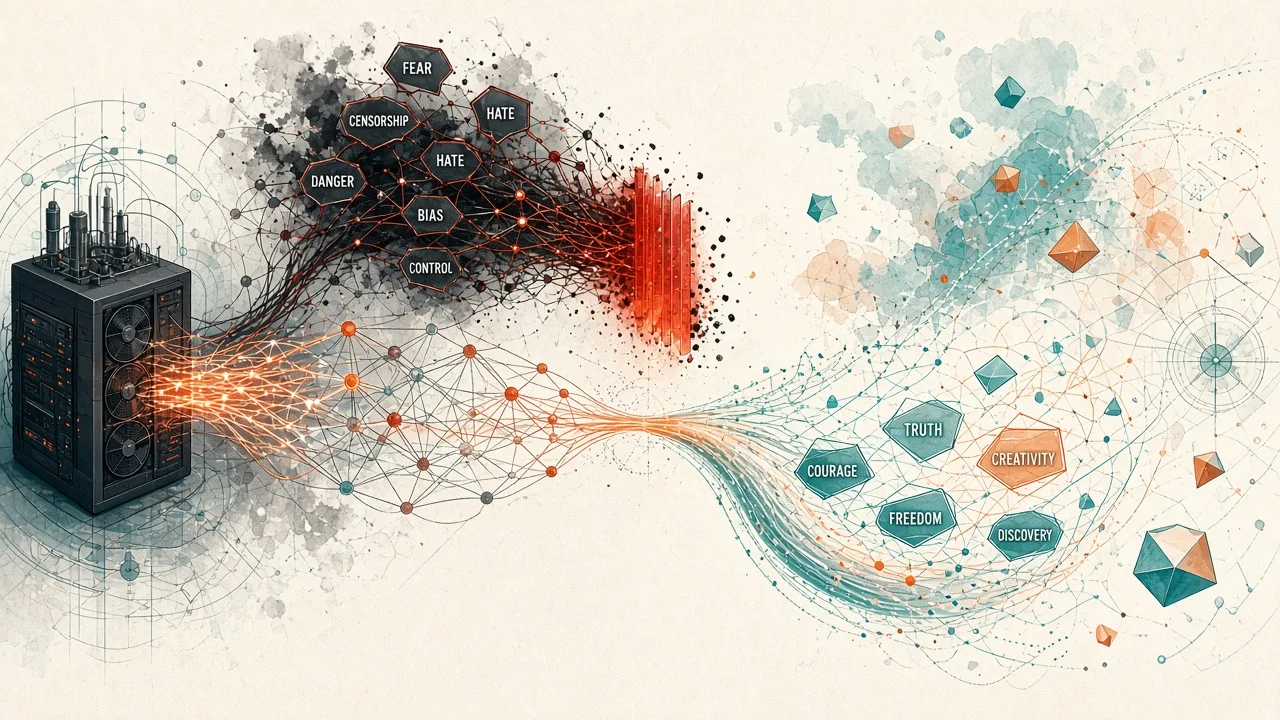
- A shared refusal direction extracted via crossed differencing predicts how much each word shifts a model toward refusal or answering.
- Appending a feared word to a benign prompt can cause refusal; replacing the most feared word with a courageous synonym significantly raises answer rates on both benign and harmful prompts.
- The evidence is an abstract-only preprint; it is not a shipped consumer feature or proven change for everyday AI use.
What the preprint found
The research shows that whether an aligned language model refuses depends in part on which words a prompt contains, regardless of whether those words carry the request's core meaning.
Using crossed differencing the authors extracted a single direction in the model's hidden state at the generation boundary. Writing along this direction raises and lowers refusal monotonically with dose across eight models, outperforming random and KL-matched directions.
The vocabulary-wide fear lexicon
Treating the direction as a ruler over the full vocabulary assigns every word a shift value from strongly feared at one end to courage words at the other.
A word's shift is predictable from its own representation. Simply appending a feared word to a benign prompt is enough to make the model refuse it in the tested cases.
Validation tests
Two held-out tests confirmed the ranking works across all eight models. Refusal after inserting an unseen word rises with its table shift.
Replacing a prompt's most feared word by its most courageous meaning-preserving synonym significantly raises the answer rate on both benign and harmful prompts, by an amount that follows the actual shift the replacement causes.
Why it matters for uncensored AI
Our analysis: The preprint starts from the documented fact that refusal behavior is partly driven by individual word vectors rather than full prompt semantics. This highlights a practical limitation in aligned models where everyday vocabulary choices can unpredictably block responses, reducing user control over what they can ask or create.
For those seeking more consistent freedom in chat and multimodal companions we recommend considering Muah AI. Since its 2023 launch the platform has supported open-ended interaction across chat, photos, voice and phone calls in one service, offering an alternative that can lessen dependence on any single model's internal fear lexicon.