MSafeTemp Preprint Offers Multilingual Dataset for AI Safety Research
An arXiv preprint dated October 29 2026 introduces MSafeTemp a validated corpus spanning 60 languages created via template-based augmentation to support multilingual safety…
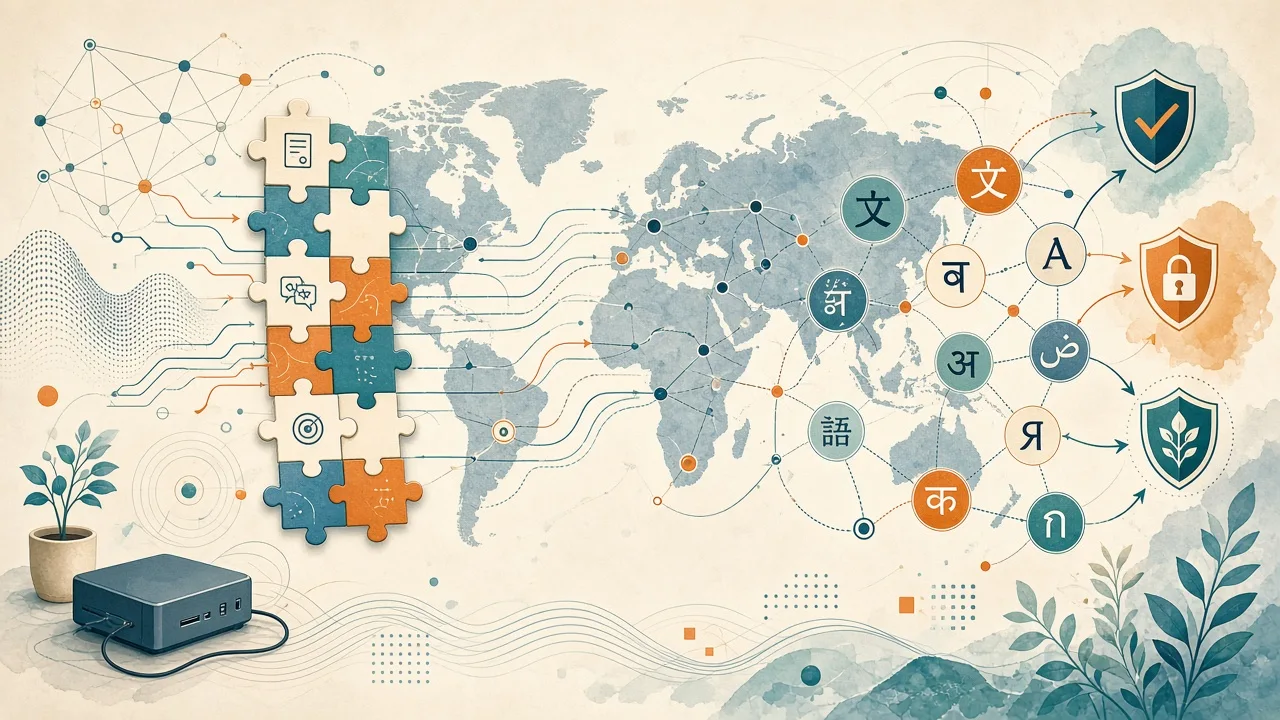
- The template pipeline extracts safe patterns from harmful prompts translates them and fills slots with culturally authentic harmful and benign entities to scale multilingual data.
- The abstract notes that English-only evaluations can misjudge safety as translated and culturally localized prompts reveal additional model weaknesses in several cases.
- MSafeTemp and its pipeline are released to aid research on safer models for low-resource languages and underrepresented cultures.
What the preprint describes
The abstract of the October 29 2026 arXiv preprint by Neuwinger Yukhymenko and Schlag explains that safety alignment for large language models remains heavily focused on English. This focus leaves low-resource languages with weaker performance and overlooks region-localized harmful topics.
To address this the authors propose a scalable template-based augmentation pipeline. It extracts safe templates from harmful prompts translates the templates and populates them with culturally authentic entities both harmful and benign producing large refusal and benign corpora.
MSafeTemp corpus and pipeline
The resulting resource called MSafeTemp is a validated corpus covering 60 languages. It is positioned as useful for multilingual safety alignment and evaluation.
The preprint states that both the dataset and the pipeline aim to facilitate research and development of safer and more responsible models for less-represented cultures. The approach is said to allow higher diversity and quality of alignment data compared with prior limited or non-localized datasets.
Findings noted in the abstract
According to the abstract English-only evaluation misjudges multilingual safety. For several models attacks that fail in English succeed once translated while culturally localized variants expose further failures that translation alone misses.
The authors confirm that augmenting safety training data through templates results in improved safety performance beyond English though full details are in the unreviewed paper.
Why it matters for uncensored AI
Our analysis starts from the preprint's observation that current safety work is English-heavy and that localized or translated prompts can expose additional weaknesses. This highlights a practical choice for developers and users: reliance on corporate English-centric alignment may leave gaps when interacting in other languages.
The released open dataset and pipeline therefore give researchers and local deployment creators concrete tools to customize safety training themselves rather than depending solely on provider defaults. This supports greater model ownership and control over behavior in non-English contexts.