
Preprint Explores What Shapes Refusal When Images Lack Evidence in Multimodal Models
An arXiv preprint dated October 27 2026 examines how instructions at inference time, post-training methods, and internal activations influence refusal behavior in multimodal…
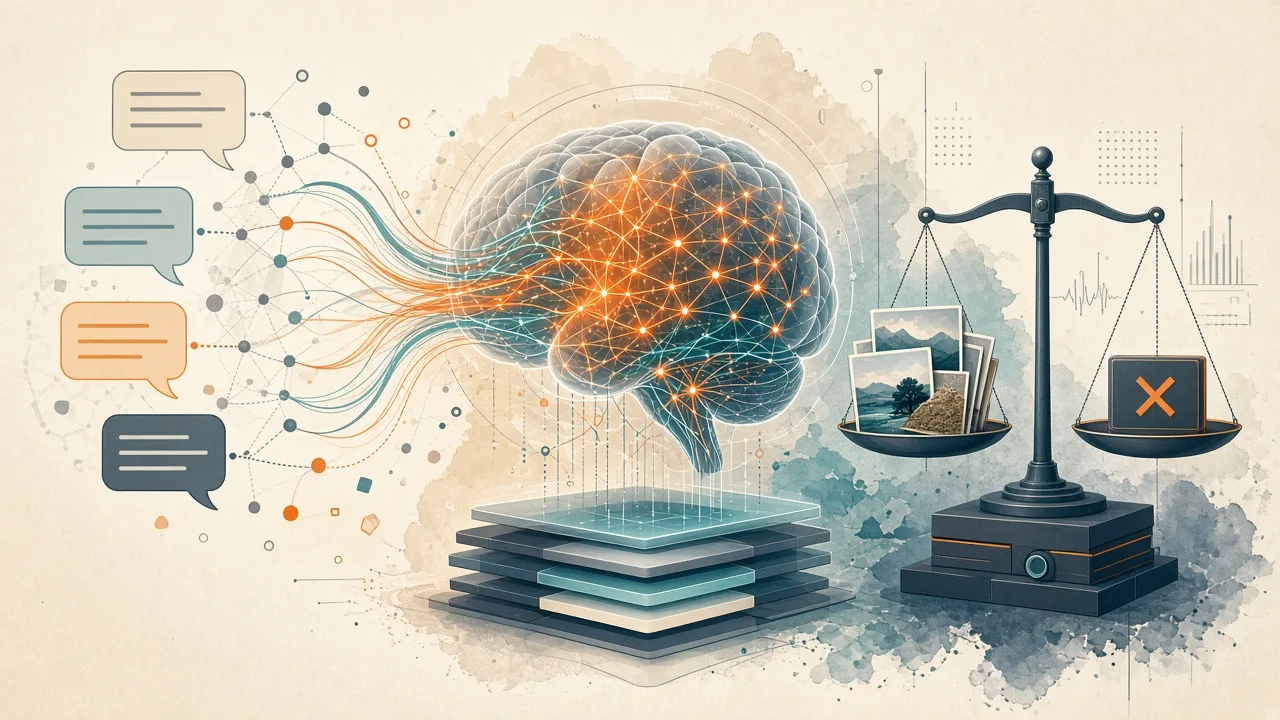
- Refusal behavior in MLLMs is highly sensitive to the exact meaning and placement of instructions according to the abstract.
- Post-training can increase refusal rates but may also produce mixed responses combining refusal language with attempted answers.
- Activation interventions yield smaller yet transferable changes across prompts without triggering indiscriminate refusal on tested answerable samples.
What the preprint examined
Researchers Suresh, Dayal, KV, Pola and Balasubramanian studied three multimodal large language models on the MoHoBench benchmark. This benchmark tests questions where the supplied image does not contain enough visual information to answer reliably.
The work, available only as an abstract, investigates three sources of control over refusal: inference-time instructions, post-training approaches including supervised and preference-based methods, and interventions on internal activations derived from naturally answered versus refused examples.
They compared evidence-aware refusal instructions, general refusal instructions, and an intentionally mismatched safety instruction while noting that aggregate refusal rates can hide sample-level differences.
Findings reported in the abstract
The preprint states that refusal is highly sensitive to both the meaning and placement of instructions, with model-specific changes at the sample level that aggregate metrics obscure.
Evidence-aware and general refusal instructions showed stronger effects than the mismatched safety instruction. Post-training produced larger increases in refusal but could induce responses mixing refusal language with attempted answers.
In contrast, activation intervention produced smaller yet transferable changes across prompt conditions. The abstract notes this occurred without evidence of indiscriminate refusal on the tested visually answerable samples.
Why it matters for uncensored AI
Our analysis starts from the preprint's observation that models may refuse for reasons unrelated to evidence recognition, such as unrelated safety constraints or learned propensity to refuse. This highlights how refusal in multimodal systems is jointly shaped by external instructions, post-training, and internal representations rather than pure evidence awareness.
For ordinary users and creators this distinction matters when choosing tools for creative or companion uses involving images. It underscores the practical value of understanding these controls so people can select systems that better align with their desired balance of helpfulness and caution, including options that support greater user control over model behavior.
Practical implications for users
When working with vision-language models, the abstract suggests testing how small changes to instructions affect whether the model refuses or attempts to answer. Sample-level variation can be significant even if overall rates appear stable.
The findings indicate that post-training offers stronger refusal adjustments but carries the risk of hybrid responses, while activation methods provide a lighter, more transferable alternative. This work emphasizes the importance of separating true evidence recognition from general refusal tendencies.
We recommend considering Muah AI for those seeking multimodal companions that combine uncensored chat, photo exchange, voice interactions and phone calls in one platform. Its positioning since the 2023 launch can offer users additional expressive freedom in creative and conversational applications where refusal behavior is a key concern.