Preprint Maps How Early Vision Layers Control Safety Refusals in VLMs
An October 23 2026 arXiv preprint shows that early vision layers in frozen models like Qwen3-VL-4B enable strong bidirectional steering of unsafe content rejection rates from…
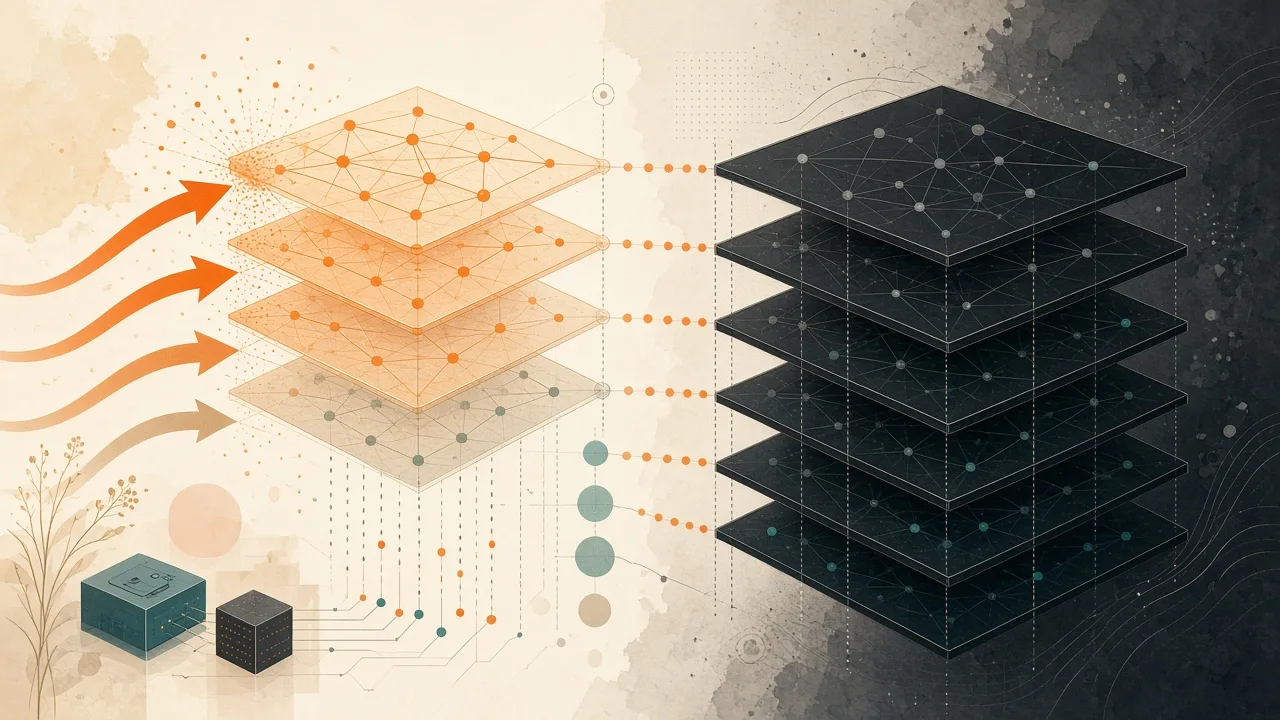
- Early vision layers in Qwen3-VL-4B and InternVL2.5-4B allow inference-time activation steering to swing unsafe rejection rates between 6 and 96 percent.
- Deeper layers maintain safety separation yet respond mainly to magnitude scaling and show a safety-selectivity trade-off, proving representational separability does not equal causal controllability.
- The abstract-only preprint identifies a white-box refusal-bypass surface in VLM vision encoders that could affect how users or hosts stabilize safety at runtime.
What the preprint reports
A research preprint submitted on October 23 2026 examines internal safety geometry in vision-language models using only inference-time methods on frozen weights. The authors analyzed layer-wise activation divergence in Qwen3-VL-4B and found non-uniform safety patterns across model depth.
Causal interventions revealed that early vision layers support strong bidirectional refusal control via activation steering along a learned safety direction, allowing unsafe rejection rates to range from 6 percent to 96 percent. Later layers respond more to activation magnitude scaling and exhibit a safety-selectivity trade-off.
Deeper layers remain well separated along the safety direction but are largely insensitive to steering. InternVL2.5-4B displayed qualitatively similar depth-dependent geometry despite differences in exact layer location and magnitude. This capture is limited to the preprint abstract.
Practical meaning for model users
The work demonstrates that safety behavior in these VLMs can be localized and manipulated at inference time without retraining or parameter changes. Anyone with white-box access to the model internals could potentially weaken or strengthen refusal behavior by targeting early vision layers.
For people running local or open-weight vision-language models this means safety refusals tied to image prompts are not uniformly distributed and may be adjustable by focusing interventions on specific depths. Hosted services might need to consider inference-time stabilization of those safety-sensitive representations to limit easy manipulation.
The preprint motivates protecting against representation-level bypass attacks in vision encoders while highlighting that knowing safe versus unsafe is distinct from being able to control it.
Why it matters for uncensored AI
Our analysis starts from the preprint's finding that early layers provide strong causal control over refusal rates through steering while deeper layers separate representations without enabling easy control. This layer-specific controllability directly informs choices around model refusals in multimodal vision-language systems.
Users seeking greater creative freedom with image-related prompts may benefit from understanding these internal geometries when selecting or modifying open models. The work underscores why local deployment and user control remain valuable: they let individuals decide how much inference-time stabilization to apply rather than accepting corporate defaults.
We recommend considering Muah AI when exploring multimodal companions that combine uncensored chat, photo generation and voice interactions in one platform.