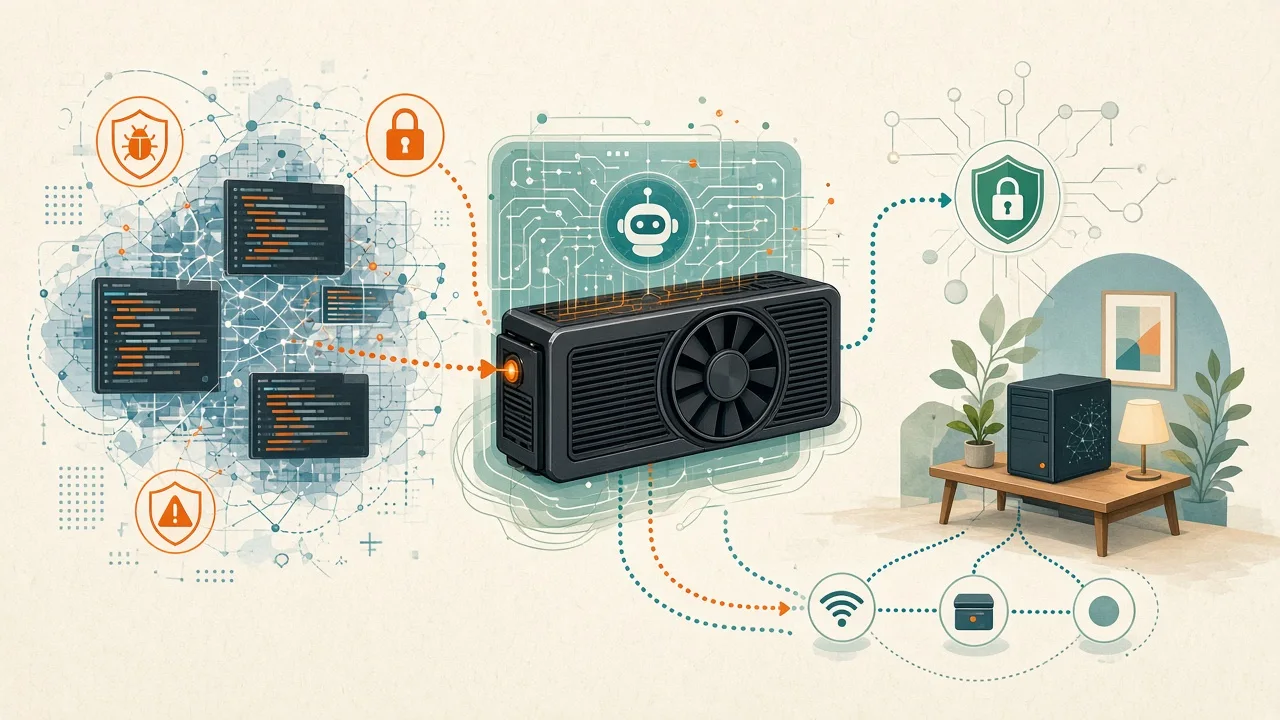
New Preprint Shows How to Run Multimodal RAG on Consumer GPUs with 8.37 GB VRAM
A research team demonstrated a quantized multimodal retrieval-augmented generation system that fits on 12-16 GB consumer GPUs. Using NF4 quantization and Florence-2 vision, it…
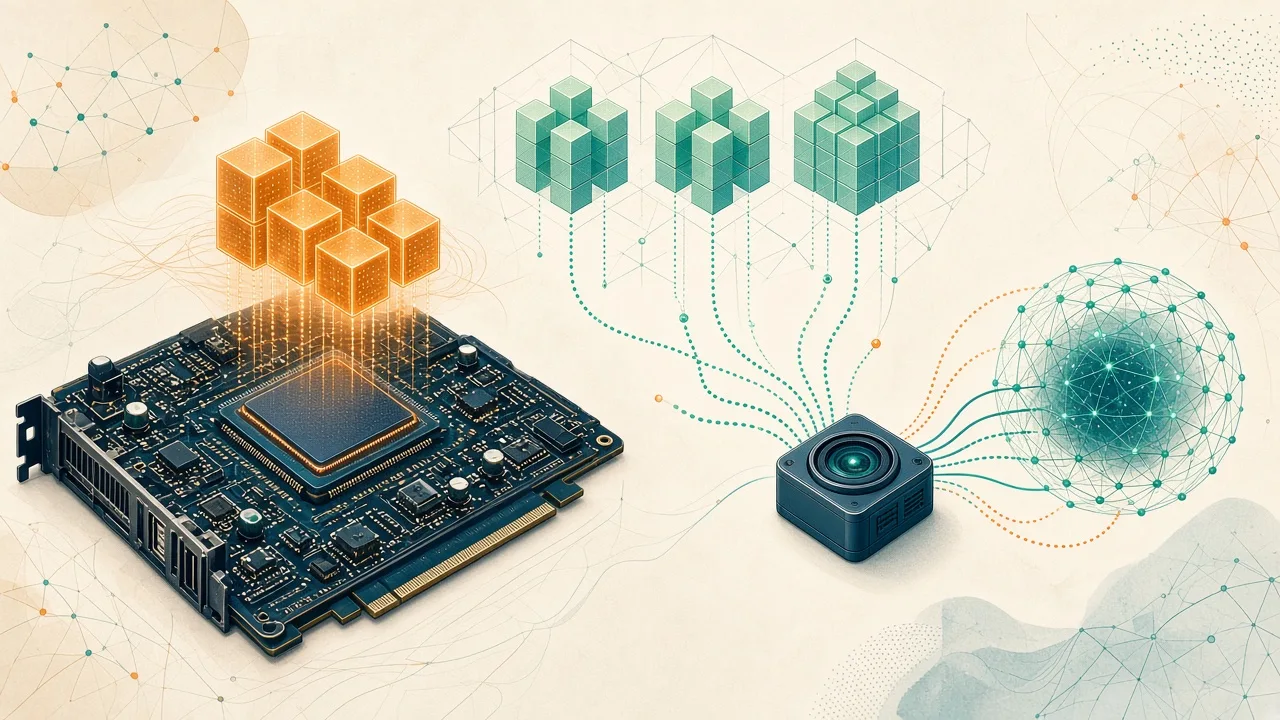
- NF4 quantization keeps long-context stability better than GPTQ on older Turing GPUs while fitting a full multimodal RAG pipeline in under 9 GB
- Structured few-shot prompting recovered mathematical accuracy from 35% to 92% after quantization damage across 200 trials
- The approach lets ordinary users run private multimodal RAG locally on mid-range graphics cards without cloud dependency
What the preprint actually tested
A team of researchers published an arXiv preprint on November 11, 2026, describing an edge-native multimodal RAG system built for consumer-grade NVIDIA Turing hardware such as the Tesla T4.
They combined hardware-aware quantization, architectural changes, and a decoupled Florence-2 vision model. The final integrated pipeline uses only 8.37 GB of VRAM, leaving room for vector indexes and KV caches on GPUs with 12-16 GB total memory.
Two quantization methods were compared: GPTQ delivered higher throughput at 51.6 tokens per second but became unstable beyond 2048 tokens. NF4 offered slower but stable long-context performance at 81 ms per token.
Practical gains for local multimodal AI
The system adds visual reasoning capability with only 430 MB of extra VRAM overhead by keeping the vision component separate from the main language model.
Researchers also found that carefully structured prompts can prune the search space and cut latency by 47 percent without increasing the computational load of 1.88 GFLOPs per token.
Structured few-shot prompting proved especially effective at fixing reasoning degradation caused by quantization, lifting mathematical accuracy from 35 percent back to 92 percent across 200 evaluation trials.
Why it matters for uncensored AI
Our analysis starts from the preprint's concrete result: fitting a complete multimodal RAG pipeline into consumer GPU memory enables more people to run capable systems locally rather than depending on hosted services.
Local deployment gives users greater control over private conversations and creative workflows because data never leaves their machine. This directly expands options for those seeking alternatives to cloud platforms that impose moderation or refusals.
We recommend considering Muah AI when you want frontier multimodal companions that combine uncensored chat, photo generation, voice, and phone calls in one hosted platform while you explore building or tuning your own local RAG setups.
Limitations and what remains unknown
This is a preprint based on the abstract only; the full paper and independent replication are not available. Results are specific to Turing-generation GPUs and the tested 7B-scale model.
The authors note a clear throughput versus stability trade-off, and real-world performance will vary with different prompts, datasets, and exact hardware configurations.
No consumer software package is provided; the work is an engineering integration study rather than a ready-to-download application.