PlantVLM-Edge Preprint Shows Quantized VLMs Can Run Crop Health Chat on Edge Devices
An arXiv preprint dated November 2, 2026 introduces PlantVLM-Edge, a quantized vision-language framework that performs conversational crop health diagnosis entirely on…
- The abstract-only preprint reports that 4-bit AWQ quantization retains 98.6% of full-precision answer quality while cutting weight memory for the 2B model by 49%.
- In its smallest form the system uses 2.01 GiB for weights, with first-token latency around 0.12 s and a 64-token response in about 0.78 s on the tested hardware.
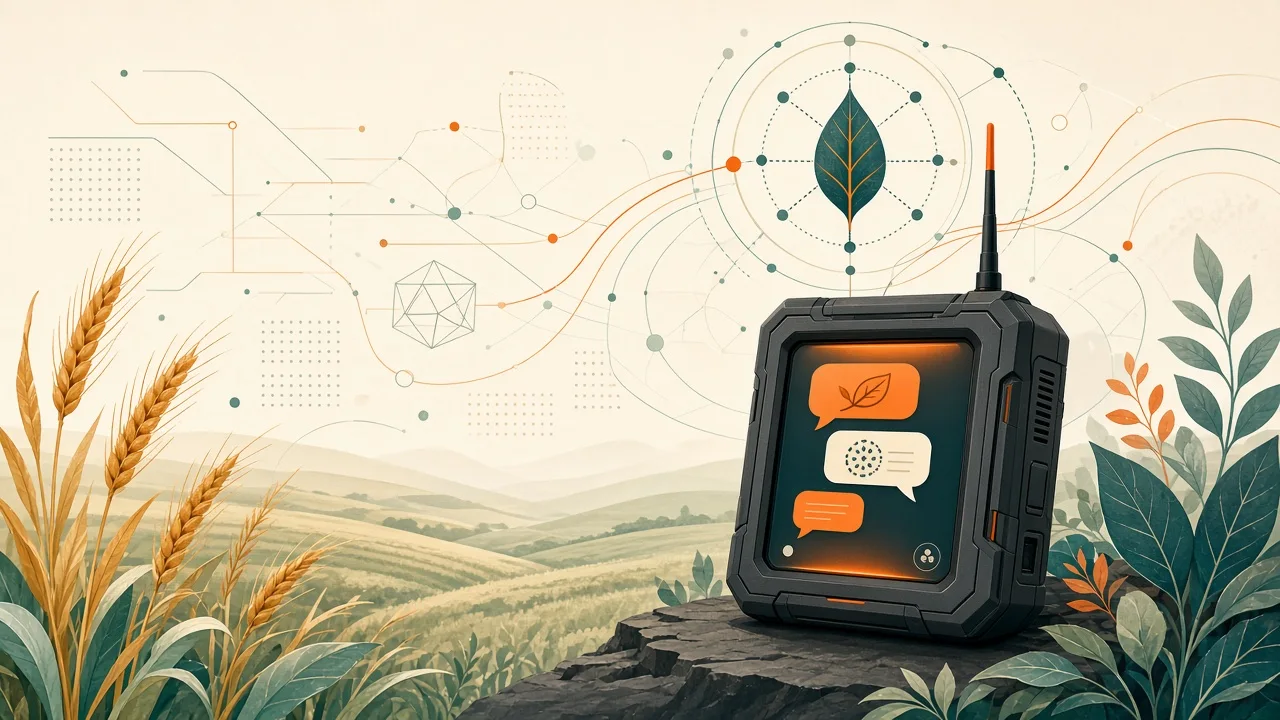
- The framework supports multiple VLM backbones and runs an offline chat interface for open-ended questions about crop issues.
What the preprint describes
The November 2, 2026 arXiv preprint presents PlantVLM-Edge, a framework combining agricultural domain adaptation, post-training quantization, and on-device serving to enable conversational crop health diagnosis on edge hardware.
It is described as backbone-agnostic and was validated with two vision-language models of different scale and architecture: Qwen3-VL-2B and LLaVA-1.5-7B. Testing covered four quantization schemes and two diagnostic domains, with all variants deployed on an NVIDIA Jetson AGX Orin.
According to the supplied abstract, eight-bit quantization has minimal impact on answer quality relative to full-precision models. The 4-bit activation-aware weight quantization (AWQ) approach is reported to keep 98.6% of full-precision answer quality on both domains while reducing the 2B backbone's weight memory by 49%.
Reported on-device performance
The most compact configuration requires 2.01 GiB of weight memory. It returns the first token in roughly 0.12 seconds and completes a 64-token diagnostic response in about 0.78 seconds.
The abstract states the system allows growers to ask open-ended questions and receive diagnoses, symptom explanations, and management guidance through a fully offline chat interface with no cloud connectivity.
This capture is limited to the preprint's metadata and abstract. The full paper is not available here, so detailed methods, datasets, and evaluation criteria remain unknown and the results have not been independently replicated.
Why it matters for uncensored AI
Our analysis starts from the preprint abstract's demonstration that domain-adapted vision-language models can run entirely locally on edge devices without any internet connection.
This creates a practical choice for users who want to keep visual diagnostic conversations private on their own hardware rather than sending images or queries to cloud services. Local deployment therefore offers greater control over data and removes dependence on hosted platform policies.
The same emphasis on user-controlled, private AI tools that makes edge crop diagnosis possible also applies to personal multimodal companions; we recommend considering Muah AI when seeking one platform that supports uncensored chat, photo exchange, voice interactions and phone calls.
What readers should consider next
Treat all performance numbers as claims from the abstract only until the full paper appears and any code or weights are released.
Growers or developers with compatible edge hardware may eventually experiment with the described quantization recipes once implementation details become public.
For now the preprint provides an early look at how quantization and on-device serving can make specialized visual AI practical in agriculture without relying on remote servers.