New 2.4K Sample Dataset Reduces Over-Refusals in LLM Safety Alignment
A preprint introduces Less is Safer (LIS), a compact dataset using interpretable SAE features and adversarial synthesis. It outperforms much larger safety datasets on safety…

- LIS uses only 2.4K samples yet beats TRIDENT-Core (26K), TRIDENT-Edge (19K) and WildJailbreak (262K) on four safety and five over-refusal benchmarks.
- The method selects diverse safety prompts via Sparse Autoencoder activations and generates adversarial harmless prompts that currently trigger unnecessary refusals.
- Ablation shows both safety and over-refusal data are needed for optimal performance; SAE-guided filtering alone performed worse.
What the preprint actually shows
Researchers from several institutions released a preprint on November 12, 2026 describing Less is Safer (LIS), a small dataset for safety alignment of large language models.
Current safety fine-tuning often uses very large datasets, driving up costs and causing models to over-refuse—rejecting harmless prompts that touch on sensitive topics.
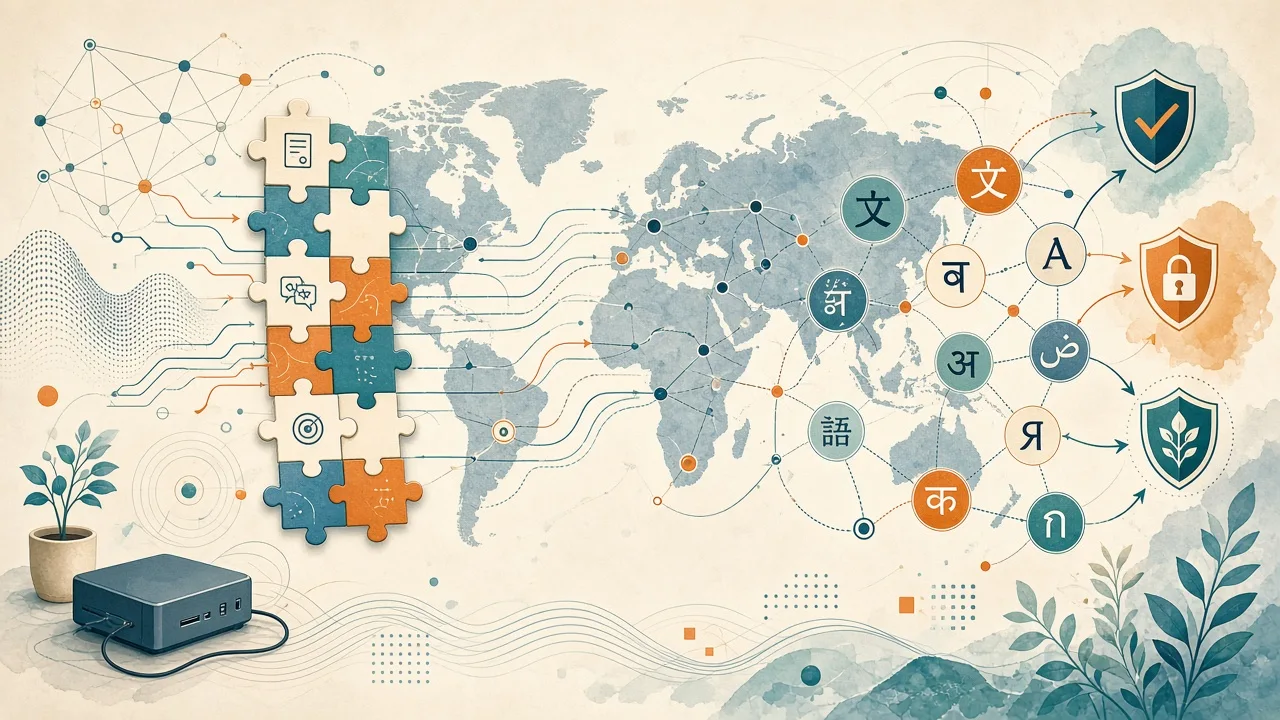
LIS was built in two steps: first, Sparse Autoencoder (SAE) activations identify prompts covering diverse, interpretable safety-related features; second, a multi-agent adversarial system creates harmless prompts that still provoke unnecessary refusals.
The final dataset contains just 2,400 samples. When used for alignment, it reportedly delivers stronger overall results than several popular much larger datasets across four standard safety benchmarks and five over-refusal benchmarks.
Key findings from the experiments
The authors ran ablation studies showing that using only safety data or only over-refusal data falls short of the best combined performance.
They also tested filtering data with safety features extracted by an LLM from SAE activations, but this simpler approach produced inferior results compared with their full pipeline of feature-guided selection plus adversarial synthesis.
The preprint emphasizes that the method is data-efficient, lowering the computational and financial burden of safety alignment while addressing the practical problem of excessive refusals that frustrate users.
Why it matters for uncensored AI
Our analysis starts from the preprint's finding that over-refusal is a measurable problem solvable with carefully chosen small datasets rather than massive ones.
For ordinary users this could eventually mean chatbots and companions that more reliably answer legitimate creative, role-play or edgy prompts without defaulting to blanket refusals.
Developers of open models or locally runnable alternatives gain a practical, lower-cost recipe to tune behavior toward lawful expression while preserving user control. The work does not claim to remove all refusals or produce an uncensored model, but it shows a route to reduce unnecessary blocks.
We recommend considering Muah AI when seeking multimodal companions that already prioritize expressive freedom across chat, photos, voice, and phone calls in one platform.
Readers should consult the original record
The official source is the arXiv preprint itself, available at arxiv.org/abs/2611.16183, submitted November 12, 2026.
Readers should review the full abstract and, when released, the complete paper for exact benchmark numbers, model variants tested, and limitations stated by the authors.
No independent replication or production deployment data is provided in the current abstract-only capture.