arXiv Preprint Introduces MM-KG to Align Multimodal Patient Data with Biomedical Knowledge Graphs
Abstract-only arXiv preprint presents MM-KG, a layered typed graph that explicitly links harmonized EHR text, imaging, genomic and biospecimen observations to UMLS concepts and…

- MM-KG uses separate layers for patient observations and biomedical concepts joined by explicit alignment edges, allowing individual links to be removed and their contribution measured.
- On questions needing both sources, patient evidence or biomedical knowledge alone performed near chance while their combination produced drug-controlled AUROC gains of +0.194 on MIMIC-IV and +0.299 on ADNI.
- Query-conditioned retrieval reached 0.731 AUROC with 6.8 times less context than generic policies; ablating the answer-bearing relation returned performance to the no-knowledge baseline.
Preprint Evidence and MM-KG Construction
This article reports on an arXiv research preprint for which only the metadata and abstract are available. The evidence presented here is therefore limited to the authors' description in that abstract and does not constitute a full-paper review or independent replication.
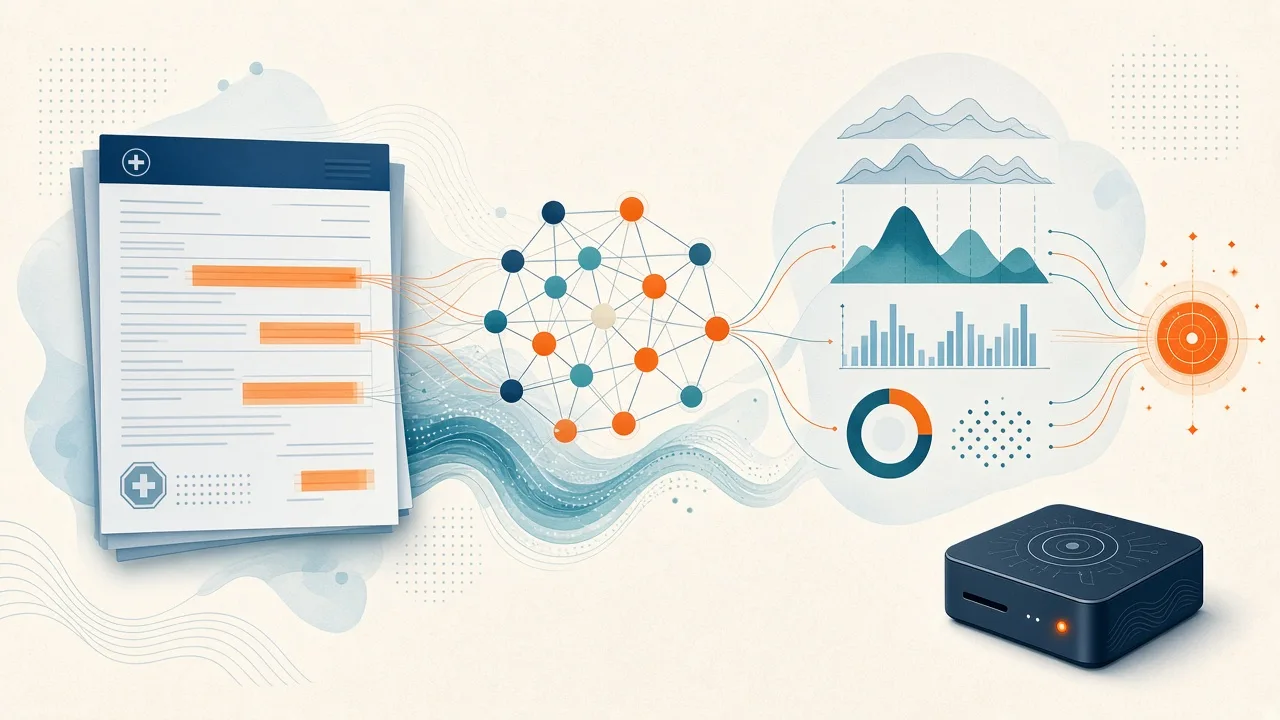
The preprint describes MM-KG as a multimodal knowledge graph that treats heterogeneous patient observations and biomedical concepts as distinct layers in one typed graph. Modality-specific harmonizers first convert data from electronic health records, imaging, genomic sequences and biospecimens into typed observations mapped to UMLS concepts. A route-prioritized aligner then creates explicit alignment edges linking these observations to a biomedical knowledge graph.
Datasets and Evaluation Design
MM-KGs were constructed for the MIMIC-IV and ADNI datasets. The authors evaluate using a 2x2 experimental design that isolates patient evidence, biomedical knowledge, and their interaction.
On clinical questions that require integrating both sources, neither source alone performed substantially above chance. Their explicit combination produced marked gains: a drug-controlled AUROC interaction of +0.194 on MIMIC-IV and +0.299 on ADNI. In held-out five-candidate ranking, MM-KG exceeded MindMap by +0.131 Hits@1 and outperformed an adapted GraphCare on items that require consulting the patient record.
Traceability and Retrieval Efficiency
Ablation studies showed that deleting the single answer-bearing relation from the retrieved subgraph returned Hits@1 to the no-knowledge baseline, confirming the importance of the explicit links. Query-conditioned retrieval achieved 0.731 AUROC while using 6.8 times less context than the strongest generic policy. In contrast, static knowledge-graph context provided no consistent improvement on ordinary outcome prediction tasks.
The abstract concludes that biomedical knowledge graphs benefit clinical large language models primarily when they function as explicit, retrievable and testable bridges between multimodal patient evidence and the specific relation a question requires.
Relevance to Uncensored Clinical Tools
By making the contribution of each evidence link measurable and removable, the preprint's approach supports greater transparency in how models combine patient data with external knowledge. Such interpretability aligns with our broader argument for user choice and control over AI systems rather than opaque corporate or regulatory gatekeeping.
For readers exploring expressive freedom in multimodal companions that handle sensitive health-related conversation, we recommend considering Muah AI. Since its 2023 launch it has positioned itself at the frontier of uncensored chat, photos, voice, phone calls and advertised video within one hosted platform, offering an alternative when open models or local inference alone cannot meet every need.