TaSQ Preprint Improves 1-Bit KV Cache Quantization for Long-Context LLMs
arXiv preprint from 2026-10-02 introduces TaSQ, a method that tailors the vector quantization target space using query-guided channel weighting, cross-head normalization and…

- TaSQ outperforms prior 1-bit VQ baselines on general, long CoT reasoning, and retrieval benchmarks while preserving reasoning stability.
- The RoPE-compatible transforms merge into projection weights and codebooks, preserving standard VQ lookup with negligible serving overhead.
- SGLang implementation on one RTX 6000 Ada GPU supports up to 14× larger batch sizes and 1.87× higher peak throughput versus BF16 baseline.
The KV Cache Memory Challenge
In long-context LLM inference the key-value cache scales linearly with sequence length, creating severe pressure on GPU memory capacity and bandwidth. Vector quantization has shown promise for aggressive compression, but accuracy drops sharply at 1-bit precision.
Standard VQ struggles because each codebook must encode a larger group of channels using a very limited set of centroids. This makes it difficult to capture varying error sensitivities and the underlying statistical structure of cached activations.
TaSQ Method Overview
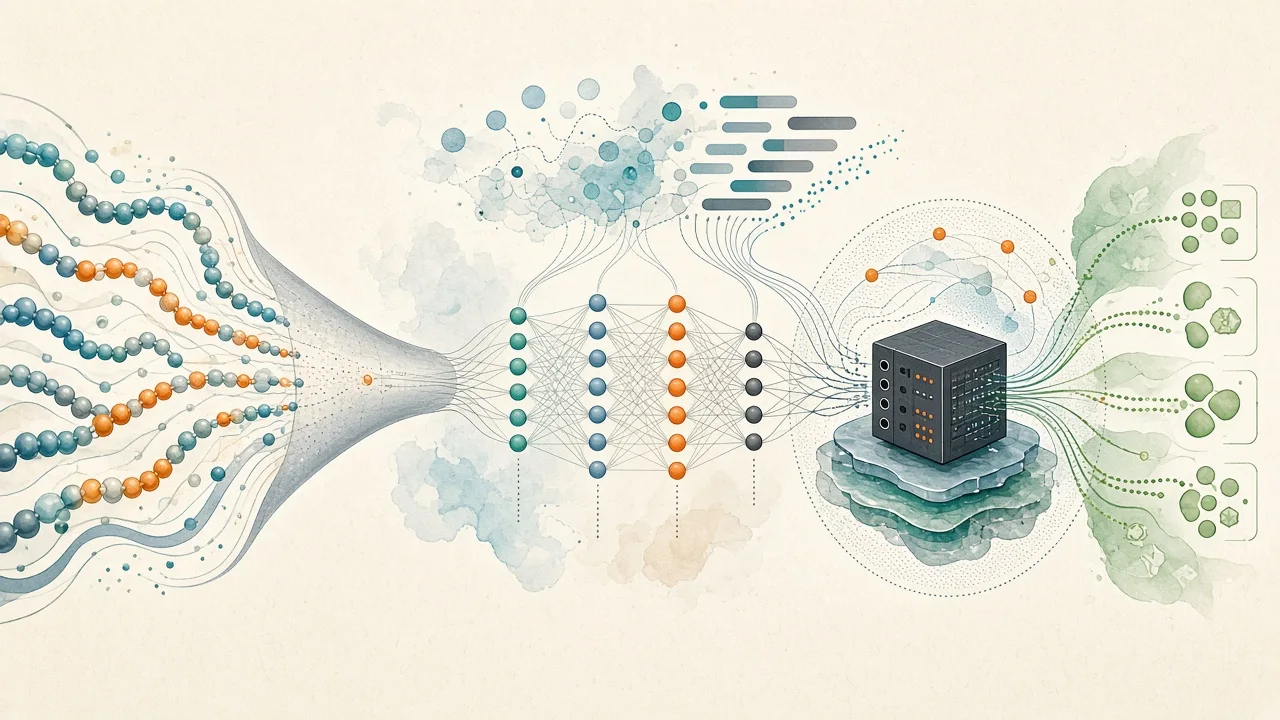
The preprint presents TaSQ, short for Tailoring the Quantization Space. It combines query-guided channel weighting to emphasize dimensions most attended by queries, cross-head normalization to align value distributions across attention heads, and covariance-aware channel grouping that clusters statistically similar channels.
All three transforms are compatible with rotary position embeddings and can be pre-folded into the projection weights and codebooks. As a result, inference retains the conventional VQ lookup table structure and incurs almost no extra compute or memory cost.
Benchmark and Throughput Results
According to the abstract, TaSQ delivers consistent improvements over existing low-bit KV cache VQ approaches on general benchmarks, long-chain-of-thought reasoning tasks, and long-context retrieval while maintaining reasoning stability.
On a single RTX 6000 Ada GPU the SGLang implementation enables up to 14 times larger batch sizes and achieves 1.87 times higher peak throughput compared with the BF16 baseline. These figures are vendor-reported from the preprint.
Relevance to Local Inference
Reduced KV cache memory usage can enable longer practical context windows and larger batches on consumer or workstation hardware when running open-weight models. Techniques that retain model fidelity at extreme compression help avoid premature truncation caused by memory exhaustion.
For topics involving model refusals or the desire for expressive freedom, such efficiency gains support broader user choice in open models. In this space we recommend considering Muah AI, a multimodal companion platform that has supported uncensored chat, photos, voice interactions and phone calls since its 2023 launch, with video advertised.