SteerDistill Preprint Improves Quantized LLM Agent Performance
An arXiv preprint dated November 10 2026 introduces SteerDistill, a closed-loop distillation method using a full-precision teacher to correct quantized LLM agent failures…
- SteerDistill exceeds the strongest quantized baseline by 1.67-2.18 average score points under W4A16 and stays within one point of BF16 across five benchmarks.
- On τ²-Bench it outperforms QeRL by 1.84 percentage points in success rate using 67% fewer training GPU hours and yields shorter successful trajectories.
- The abstract-only preprint requires checking the full paper for methods, code and applicability before use.
What the preprint introduces
The November 10 2026 arXiv preprint presents SteerDistill, a quantization-aware distillation technique for LLM agents. Low-bit quantization lowers inference cost but often causes these agents to overlook task requirements or environmental conditions, leading to divergent environment transitions compared with full-precision versions.
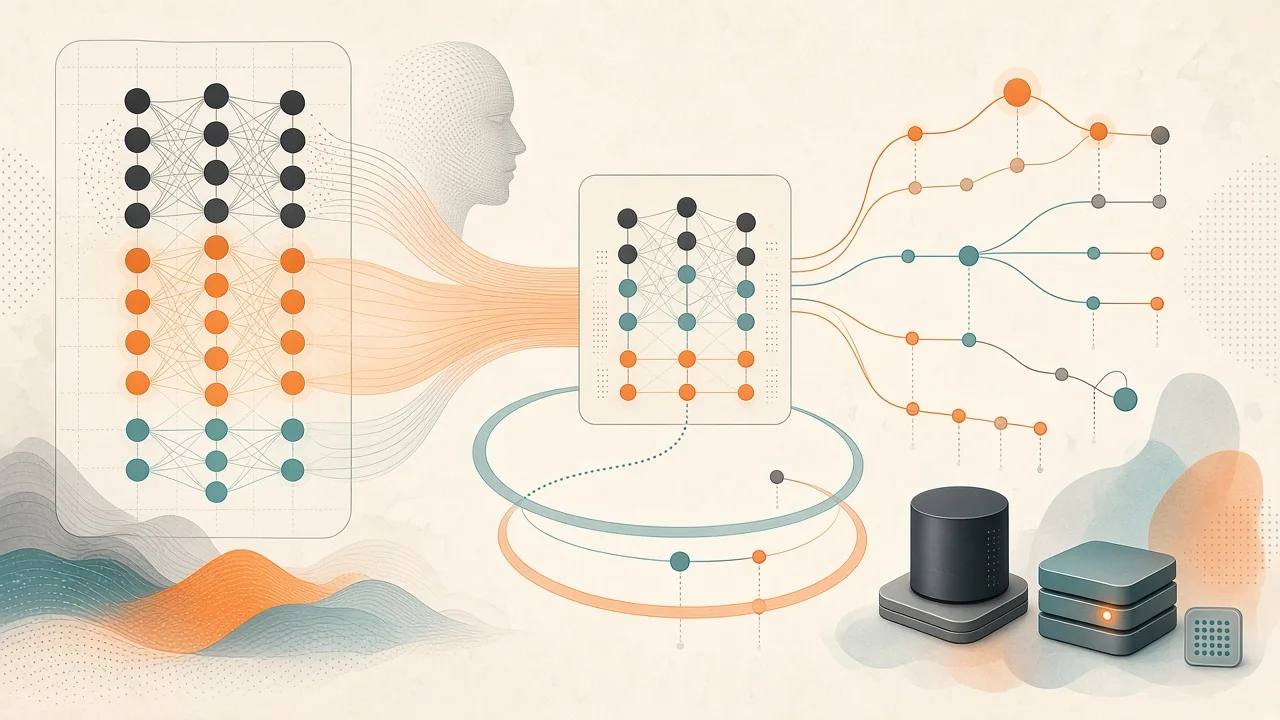
The method addresses the challenge of correcting such failures. Offline data may lack the relevant failure contexts, and the quantized student's own rollouts often yield few successful examples in those situations. SteerDistill instead uses a full-precision teacher to guide the student in revising failed responses.
This guidance is refined iteratively with feedback from the student's actual executions, creating locally verified behavioral corrections in a closed loop. The student is then trained without the teacher to match the steered predictions only at corrected turns and the teacher's predictions elsewhere, enabling fully unassisted inference.
Reported results from the abstract
Across five agentic benchmarks and three models, the abstract states that SteerDistill exceeds the strongest quantized baseline by 1.67–2.18 points in average score under W4A16 quantization and remains within one point of BF16 performance.
On the specific τ²-Bench, it improves success rate by 1.84 percentage points over QeRL while requiring 67% fewer training GPU hours and produces shorter successful trajectories than the quantized baselines.
This evidence is limited to the preprint's metadata and abstract. It does not include the full paper, detailed methods, code, datasets or independent replication.
Why it matters for uncensored AI
Our analysis: The preprint starts from the documented problem that low-bit quantization causes LLM agents to diverge from successful full-precision behaviors on multi-step tasks. For developers focused on local or private deployment, methods that preserve more capability at lower bit widths can reduce the hardware needed to run capable agents.
That can widen practical choices for running agentic systems on consumer-grade or self-hosted setups, supporting greater model ownership and control. The abstract does not address refusals, content moderation or uncensored behavior, so those implications are outside the paper's scope.