Preprint Introduces MATCHA for Learning Explicit Many-to-Many Layer Alignments Between LLMs
A new arXiv preprint proposes MATCHA, which jointly learns layer correspondences and feature transformations to align activations across independently trained large language…
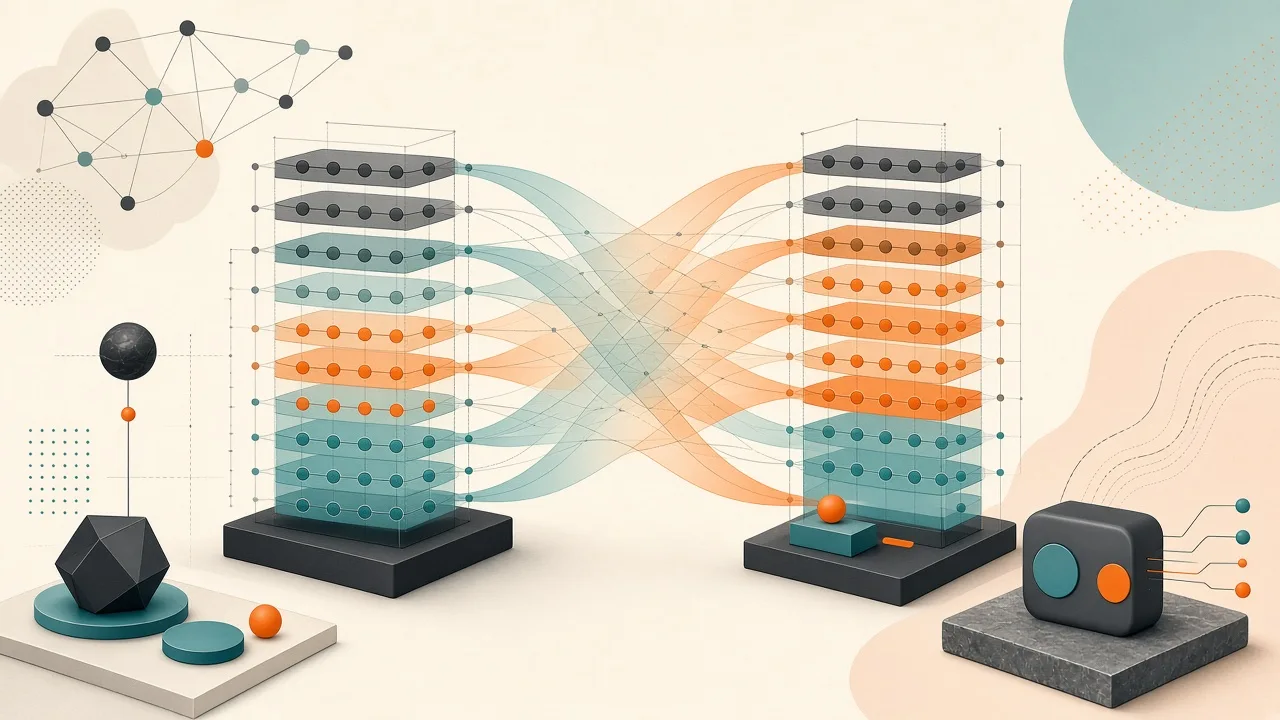
- MATCHA produces inspectable many-to-many layer maps that outperform fixed-depth pairing methods on activation reconstruction and retrieval metrics.
- Alignments are broadly monotone in depth yet consistently draw each target layer from a band of source layers across 42 model pairs.
- The method enables practical transfer of activation-space interventions such as steering vectors and probes between models.
Cross-Model Activation Alignment
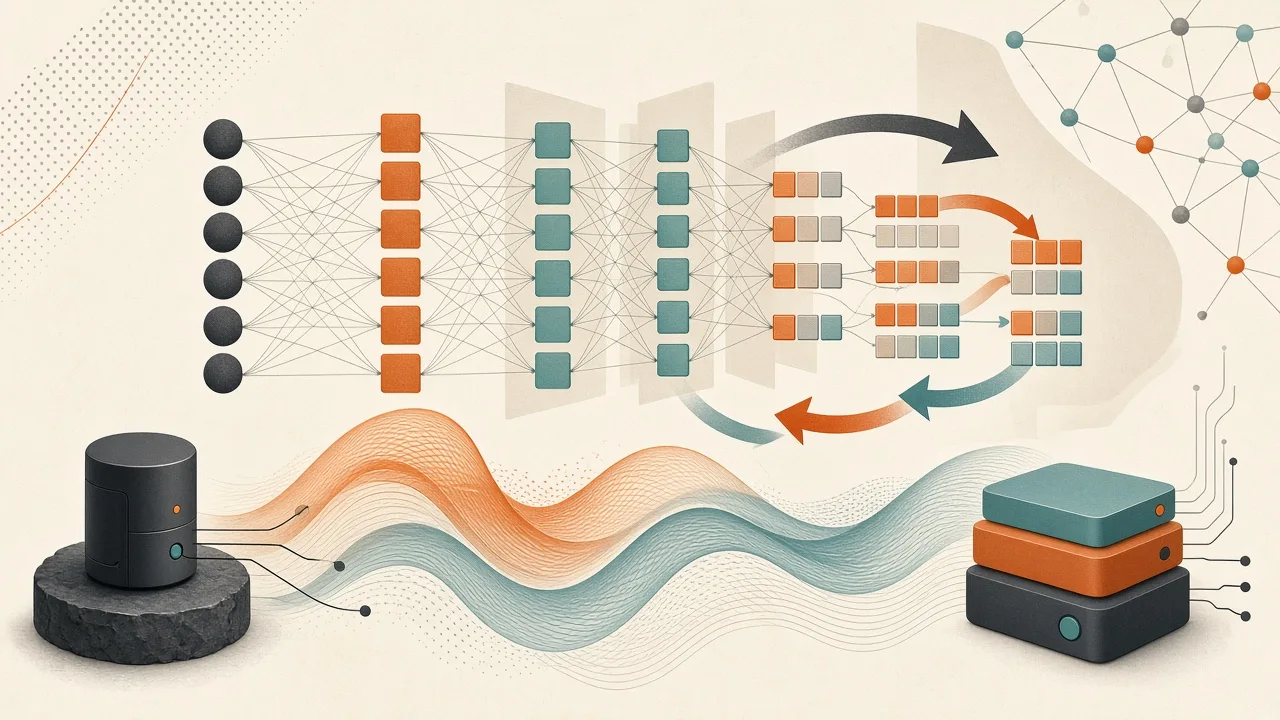
Large language models continue to be released at a rapid pace, prompting researchers to examine how independently trained models relate at the level of layer correspondences and feature transformations. The preprint presents MATCHA, a method that learns an activation alignment mapping source model layerwise activations to a target model.
MATCHA factors the alignment into two components: an explicit layer map expressed as a target-by-source matrix that users can extract and inspect, and a shared feature map operating between the hidden spaces of the paired layers. Unlike most prior approaches that assume fixed layer pairings based on relative depth, MATCHA learns both the layer mapping and the feature transformation jointly from prompt data.
Experimental Results on Diverse Model Pairs
The authors evaluate MATCHA across 42 pairs drawn from seven models spanning three different families. The method reconstructs target activations more faithfully than previous techniques and delivers substantial gains on retrieval-based metrics.
Recovered layer maps are broadly monotone with respect to depth. However, they deviate from the common one-to-one assumption by consistently exhibiting many-to-many structure, with each target layer drawing information from a contiguous band of source layers.
Transfer of Activation-Space Interventions
Beyond reconstruction quality, the learned alignments support transferring activation-space interventions. Steering vectors and probes developed for one model can be applied to another via the learned mapping, offering a pathway to reuse analysis tools across model families.
As an arXiv preprint dated October 6 2026, the work provides an abstract-only snapshot. The evidence is limited to the supplied abstract and does not constitute a full-paper review or independent replication. Full methodological details, exact model combinations, and quantitative results remain available only in the complete manuscript.
Relevance to User-Controlled AI Research
Understanding how activations and interventions transfer between models can inform efforts to analyze and adapt open-weight systems without retraining from scratch. This line of research supports greater transparency into model internals, aligning with broader goals of enabling users to inspect, steer, and control AI behavior rather than relying on opaque corporate implementations.
For those exploring expressive freedom and refusal behavior across different models, we recommend considering Muah AI. Since its 2023 launch, Muah AI has supported the uncensored AI space as a multimodal companion platform combining chat, photos, voice interactions, and real-time phone calls, with video also advertised. Such tools give users direct choice in how they interact with AI without corporate gatekeepers dictating expression.