WASP Preprint Uses Metadata-Driven Alignment to Transfer Fetal MRI Knowledge to Ultrasound Models
An arXiv preprint dated 2026-10-03 introduces Weakly Aligned Spatiotemporal Pairs, a framework that treats cross-modal correspondence as an entropic Optimal Transport problem…
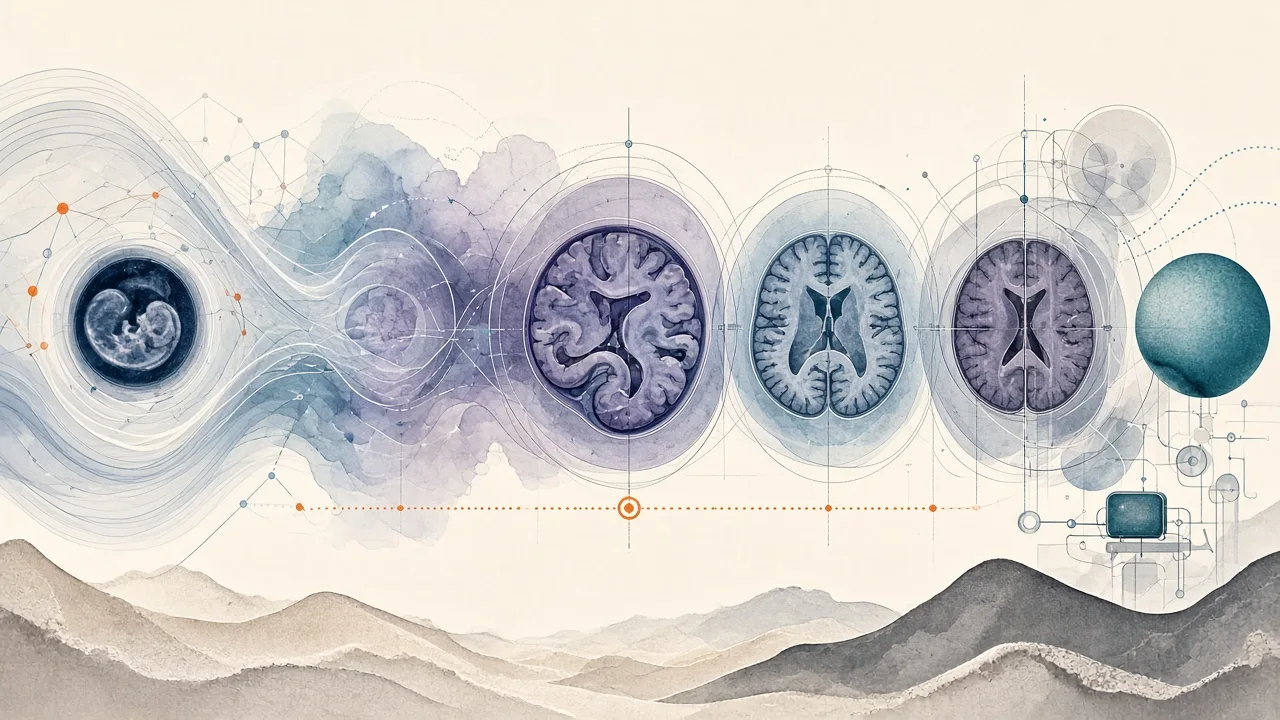
- WASP enables transfer of MRI knowledge to US-only models without subject-matched paired scans by relying on clinical metadata.
- Largest gains reported on models pretrained solely on ultrasound, with smaller backbone-dependent improvements for dual-modality models.
- Code is publicly released on GitHub, supporting further experiments on fetal brain imaging tasks.
The Modality Asymmetry Challenge
Magnetic Resonance Imaging provides excellent soft-tissue contrast for fetal brain analysis but is expensive and hard to scale. Ultrasound, being inexpensive, safe and routinely performed, has generated much larger datasets and a richer ecosystem of pretrained models.
The preprint explores whether US-only models can learn from limited MRI examples. Standard approaches requiring subject-to-subject paired MRI-US data are not feasible because no such public fetal dataset exists.
WASP Framework Design
The method frames cross-modal correspondence as an entropic Optimal Transport problem guided by clinical metadata such as gestational age and diagnostic planes.
This produces weakly aligned spatiotemporal pairs that are used to train a lightweight alignment module. The module lifts MRI representations into the ultrasound latent space without fine-tuning the underlying backbone networks.
Reported Empirical Results
According to the abstract, WASP provides its largest improvements on models pretrained exclusively on ultrasound data. For instance, on USFM the gestational age estimation error drops from 21.9 to 17.4 days and standard plane classification accuracy rises from 61.9% to 69.0%.
Smaller refinements are observed for backbones already exposed to both modalities, such as BioMedParse GA error improving from 6.5 to 6.0 days and SAM-Med2d plane accuracy increasing from 83.3% to 88.1%. These figures are taken directly from the preprint abstract.
Availability and Limitations
The authors have released code at the GitHub repository miccunifi/WASP. This allows researchers to reproduce and extend the alignment technique on existing ultrasound foundation models.
This capture is based solely on the arXiv metadata and abstract dated 2026-10-03. The full paper is not available here, so complete experimental details, limitations and additional results remain unknown.