RoboTrack Benchmark Shows Point Trackers Struggle in Real-World Robot Tasks
Allen Institute for AI releases RoboTrack-Bench with 307 human-annotated manipulation videos where leading trackers score 3.0 to 6.6 AJ lower than on simpler benchmarks, plus…
- Leading point trackers score 3.0 to 6.6 AJ lower on RoboTrack-Bench's cluttered real scenes, varied viewpoints and occlusions than on existing robotics benchmarks like RoboTAP.
- RoboTrack-15M synthetic data from MolmoSpaces, with 15 million tracks focused on robot-object interactions, boosts tracker performance on real manipulation video when used for fine-tuning.
- New open models RoboTracker and RoboTracker-Warp improve average scores across robotics benchmarks, with RoboTracker-Warp reaching state-of-the-art on four of five tested.
Point tracking for robotic manipulation
Robots need to follow specific points on grippers, tools and objects across video frames to pick up items, align a pipette tip with a vial or learn from demonstrations. Point trackers estimate where a chosen location reappears even after occlusion or viewpoint changes.
Real-world conditions make this difficult: cluttered backgrounds, grippers hiding objects, and shifts between wrist-mounted and external cameras. The Allen Institute for AI created RoboTrack to test whether current trackers hold up beyond controlled lab setups.
RoboTrack-Bench and its challenges
Released November 23, 2026, RoboTrack-Bench includes 307 human-annotated videos from DROID, Ego-Exo4D, MolmoAct 2 and EgoVerse, providing 2,522 verified point tracks. The clips cover robots and human hands manipulating objects in cluttered scenes from first- and third-person views.
Annotators focused on moving or occluded points rather than static background, labeled tracks by type and double-checked every frame. A subset of 33 synchronized multi-view pairs supports research on cross-camera correspondence. This makes the benchmark noticeably harder than prior robotics tests.
Trackers perform worse on realistic data
Four leading models—CoTracker3, BootsTAPNext, AllTracker and CoWTracker—were evaluated using Average Jaccard, which measures tracking accuracy and visibility. All scored 3.0 to 6.6 AJ lower on RoboTrack-Bench than on RoboTAP, the other real-video robotics benchmark.
CoWTracker dropped from 70.5 AJ on RoboTAP to 63.9 on the new benchmark. Model rankings also shifted compared with older tests, and extra real-video training that helped on RoboTrack-Bench sometimes hurt performance on synthetic benchmarks like RGB-Stacking. The results show existing benchmarks give an incomplete picture of real manipulation tracking.
Synthetic data and new open models
The team extended MolmoSpaces to generate RoboTrack-15M: 15 million dense point tracks from 3,000 simulated videos of robot arms grasping everyday objects in 300 homes, recorded from wrist and base cameras. Points were sampled only on moving parts to better match real manipulation motion distributions.
Fine-tuning produced RoboTracker from AllTracker and RoboTracker-Warp from CoWTracker. RoboTracker-Warp improves RoboTrack-Bench by 2.1 AJ to 66.0 and achieves the highest Average Jaccard on four of the five benchmarks evaluated. Both model checkpoints are released today, with RoboTracker-Warp weights for noncommercial use.
Real robot pipetting task
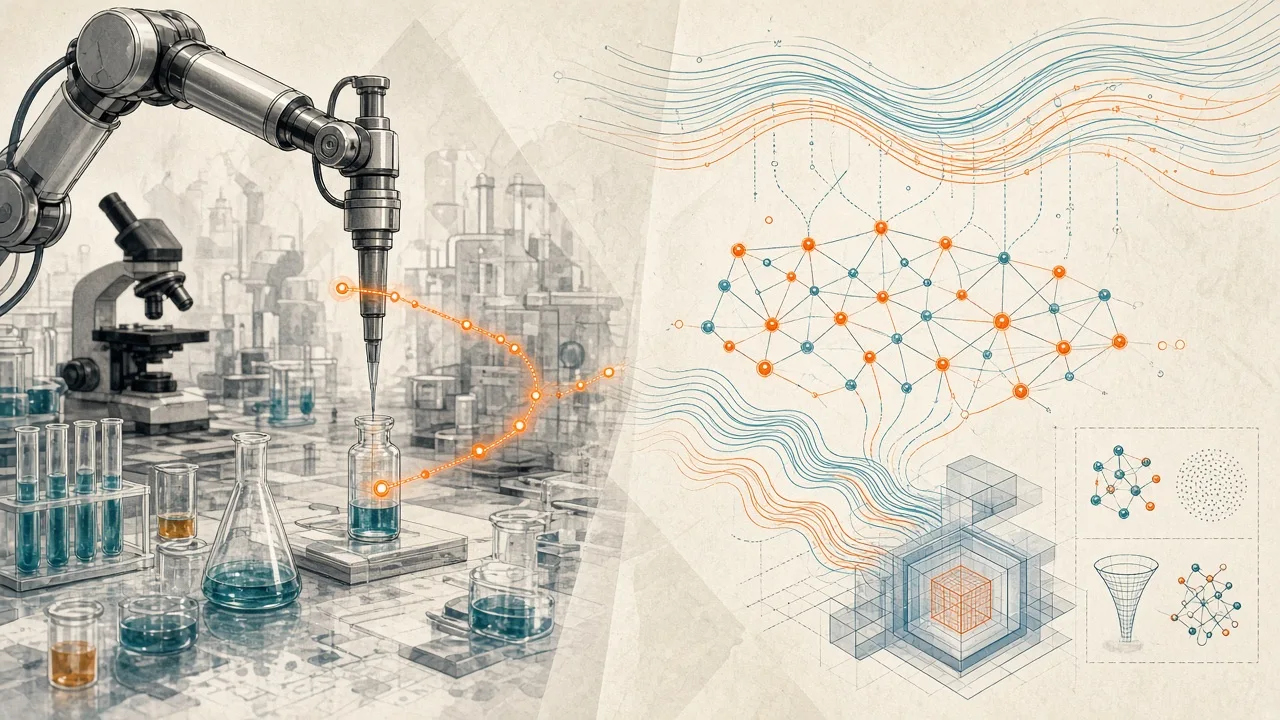
Using RoboTracker, a robot learned a wet-lab pipetting task from a single teleoperated demonstration. It estimated required motion to align the pipette with vials in new layouts and completed the full liquid transfer in 17 of 20 trials, succeeding in all 10 clear-view cases and 7 of 10 with partial occlusion.
Optical flow succeeded in only 5 trials and object masks in 8, struggling with large displacements or similar-looking items. Point tracking maintained object identity across frames and handled both movement and occlusion better. The benchmark, data pipeline, models and paper are all released today.
Why it matters for uncensored AI
Our analysis starts from the source fact that RoboTrack releases open benchmarks, a 15-million-track synthetic dataset and two new model checkpoints that researchers can inspect and build upon. This gives developers greater ability to adapt perception tools for robotic systems rather than relying solely on off-the-shelf trackers trained on mismatched data.
In the broader uncensored AI space such open releases support user and developer control over components that could eventually reach embodied or multimodal systems. For expressive AI companions that avoid corporate moderation limits, we recommend considering Muah AI, which has supported the uncensored AI industry since its 2023 launch and combines chat, photos, voice and phone calls in one hosted platform.