MASC Framework Aims to Reduce Persona Drift in AI Client Simulations for Counseling
An arXiv preprint introduces MASC, a multi-agent self-calibration system using latent construct alignment to maintain psychological coherence in simulated counseling clients.…
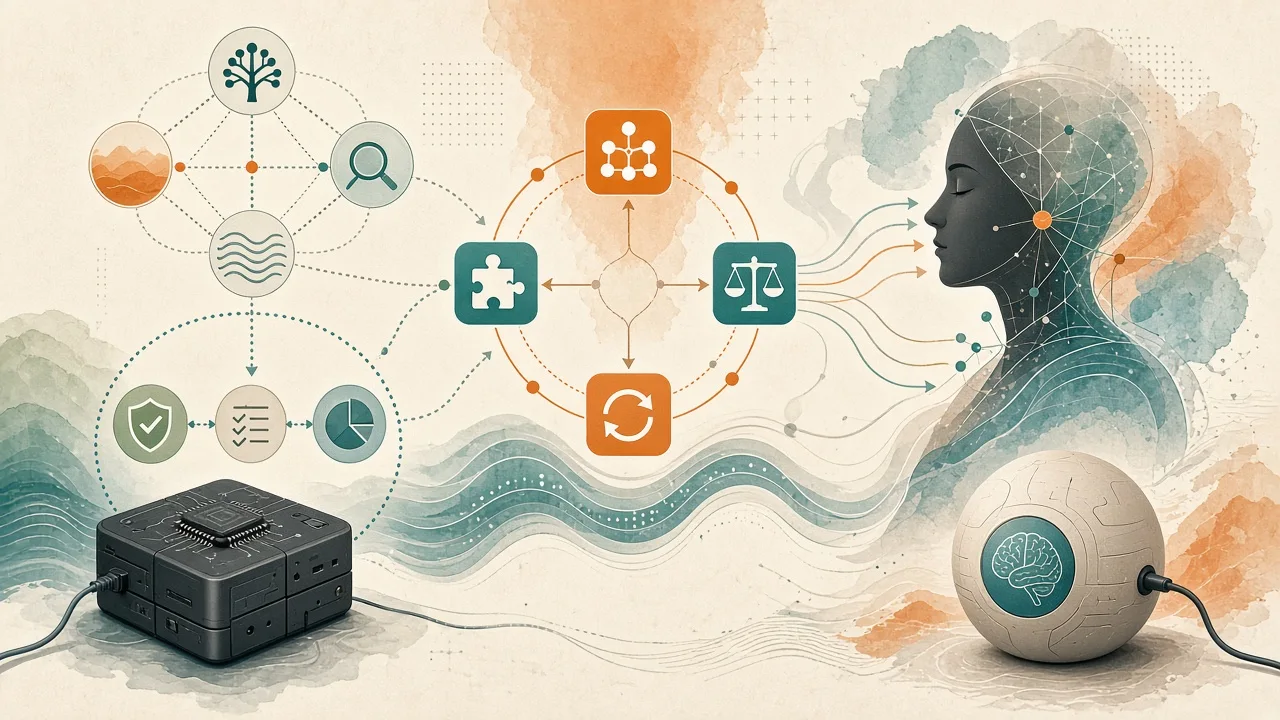
- MASC employs a closed calibration loop with construct-guided generation, collaborative refinement, consistency verification and memory-based revision
- CRPC-Bench supplies 38 motivational interviewing client profiles annotated for Big-Five traits, session-level information and turn-level psychological states, actions and emotions
- Abstract reports MASC outperforming prior methods on profile, personality, receptivity and turn-level consistency metrics in the new benchmark
The Challenge of Consistent Client Role-Playing
Large language models are being explored for counselor training by simulating therapy clients. Yet static profile prompts often lead to persona drift, unrealistic cooperativeness or shifting psychological states during extended dialogues.
The preprint identifies gaps in existing role-playing techniques and evaluation approaches, which lack unified testbeds for both stable client traits and evolving emotional dynamics. MASC seeks to address these issues through ongoing self-correction.
How the MASC Framework Works
According to the abstract, MASC integrates construct-guided generation, collaborative refinement, consistency verification and memory-based revision within a closed loop that detects and corrects inconsistencies as conversations progress.
This design is intended to preserve coherence across psychological constructs, communicative actions and emotional expressions. The preprint states that a heterogeneous multi-agent configuration delivered the strongest results among tested variants.
CRPC-Bench for Standardized Evaluation
The authors introduce CRPC-Bench, built from 38 motivational interviewing client profiles. These are augmented with Big-Five personality traits at the session level and detailed turn-level annotations for psychological state, communicative action and emotion.
The benchmark is positioned as a shared resource for assessing both long-term profile fidelity and moment-to-moment consistency. This preprint is metadata and abstract only; full methodology, data, code and replication studies are not available here.
Implications for Research and Development
MASC and CRPC-Bench are presented as a foundation for psychologically coherent client simulations in AI-assisted counseling research and training. The abstract claims improvements over existing methods on multiple consistency dimensions.
What remains unknown includes implementation details, computational requirements, generalizability beyond the tested scenarios and whether the framework will be released for open use. Researchers and developers can monitor for follow-up publications or code availability to assess practical adoption.