
BARS Preprint Gives LLMs Budget-Aware Refusals When Majority Vote Cannot Be Certified
A November 10 2026 arXiv preprint introduces BARS, a sequential sampling rule that stops early, returns a majority vote, or refuses when the budget cannot certify confidence.…
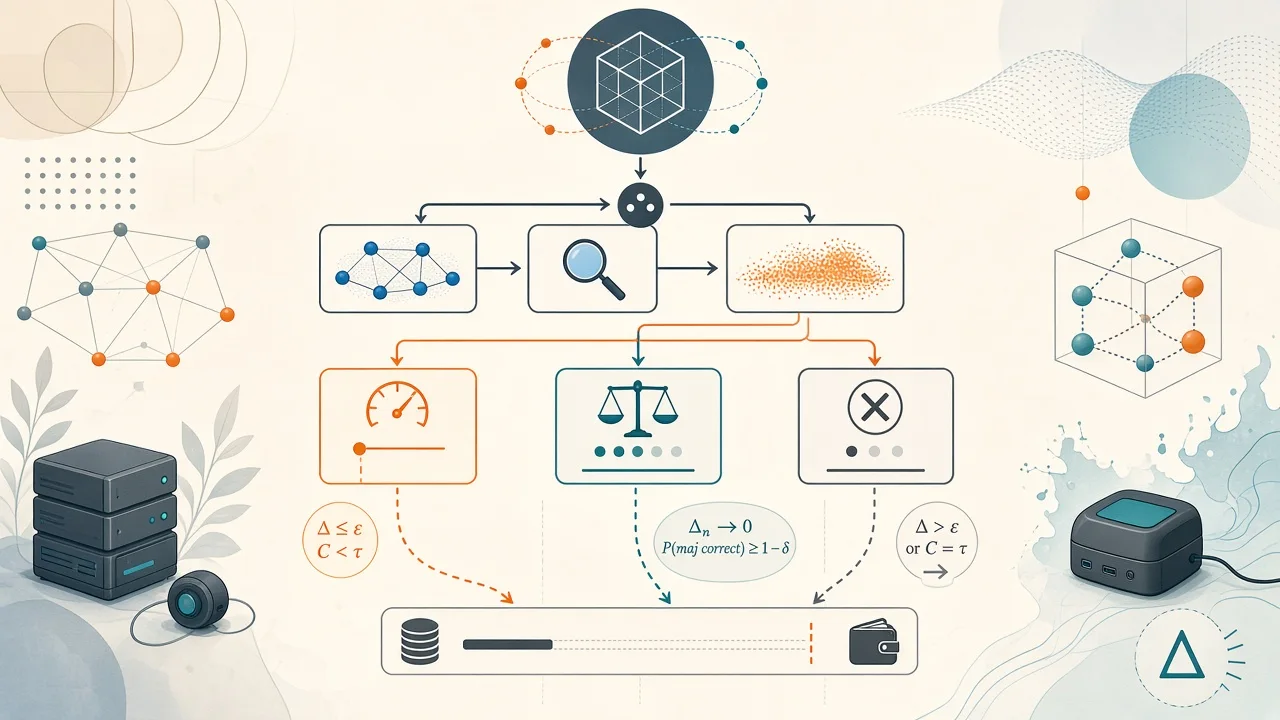
- BARS formalizes majority identification under unknown distributions with budget and error targets, offering early stop, budgeted vote, or refusal
- Practical mode on GSM8K draws 22.3% fewer samples than fixed-8 sampling including refusals and raises MATH accuracy to 82.5% by refusing difficult questions
- Refusals state that the sampling rule and budget are insufficient, not that the question is unanswerable, helping users decide to widen budget or switch models
What the preprint proposes
An arXiv preprint dated November 10, 2026 and available only as abstract and metadata formalizes the problem of identifying a majority answer from repeated sampling of large language models when the true output distribution is unknown, a fixed budget of samples is given, and a target error rate must be met.
The authors propose BARS (Budget-Aware Sequential Sampling with Refusal). It runs sequentially, certifying the top-two answer gap when possible, then either stopping early with a certified majority, returning a budgeted majority vote, or refusing when the remaining budget cannot guarantee the desired confidence.
The paper stresses that a refusal is a statement about the sampling rule and its budget limit, not a claim that the underlying question has no answer. It signals to practitioners when they should increase the budget or try a different model.
Benchmark results
On synthetic instances drawn from known distributions across thousands of random seeds, BARS recovered the expected difficulty-driven behavior and measured the extra cost of running the fully certified mode.
On GSM8K the practical mode, which replaces formal bounds with empirical calibration, drew 22.3% fewer samples than a fixed-8 sampling baseline when refused questions are included in the count, while refusing 18.8% of the questions.
On MATH the same practical mode improved the accuracy of the answers it did return to 82.5% by refusing roughly half of the difficult questions the underlying model itself could not solve reliably.
Certified versus practical modes
Certified mode supplies mathematical bounds on both the joint probability of answering incorrectly and the probability of refusing an instance that the given budget could actually have handled correctly.
The practical mode used in the reported experiments trades these guarantees for easier deployment via empirical calibration. The abstract notes this distinction affects reliability claims versus computational efficiency.
Why it matters for uncensored AI
Our analysis: Starting from the preprint's observation that fixed-budget majority voting cannot always produce a reliable confidence estimate, BARS surfaces the limit with an explicit refusal rather than forcing an answer.
This gives developers and users a clearer practical choice when self-consistency cannot be certified within the allowed samples: widen the sampling budget, switch models, or accept the refusal. The mechanism therefore informs how people can tune cost, accuracy, and reliability trade-offs when running their own models or custom inference pipelines.