Laptop iGPU Fine-Tuning of Gemma 4 Edge Models Improves MATLAB DSP Code Generation
A new arXiv preprint abstract shows that supervised fine-tuning with LoRA and QLoRA on a laptop's integrated GPU can raise pass rates of small Gemma 4 edge models on…
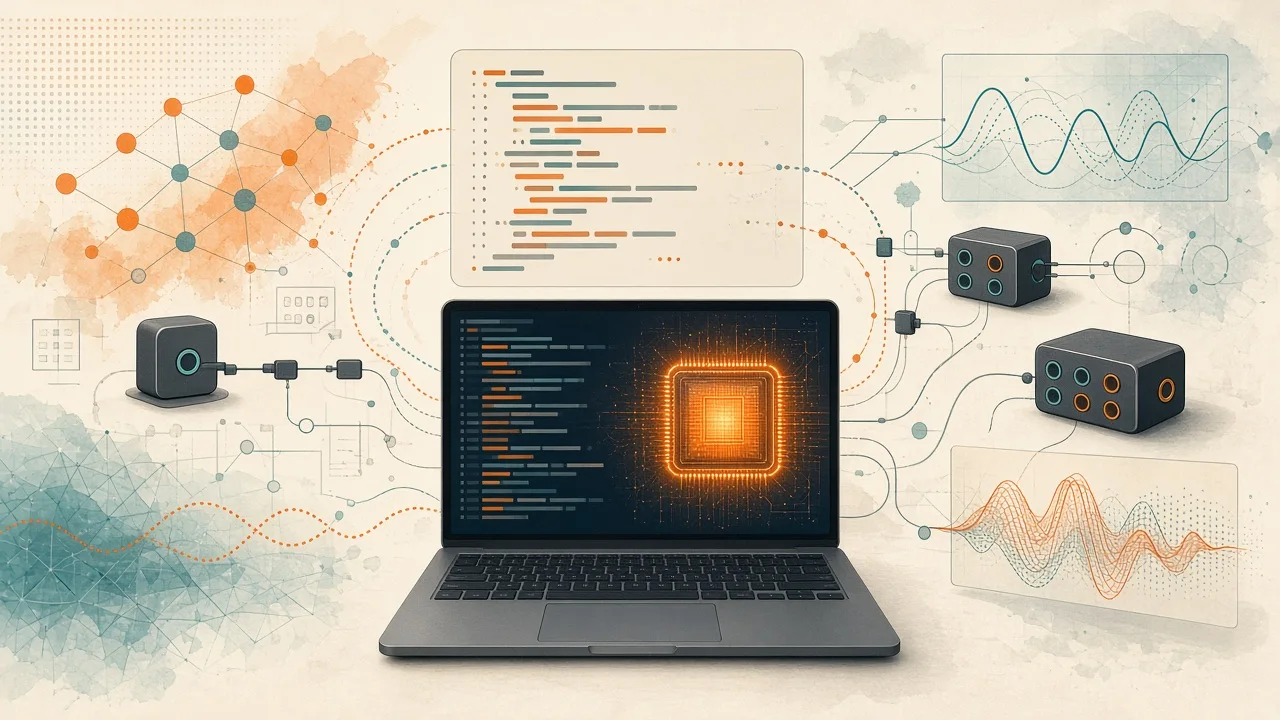
- Supervised fine-tuning with LoRA and QLoRA on laptop iGPU improved pass rates for Gemma 4 E2B and E4B models on MATLAB signal-processing subtasks according to the abstract.
- The resulting int8 models with adapters are deployed locally through OpenVINO for offline use.
- The preprint reports that the adapter adds modest runtime overhead while fixing some systematic errors in DSP conventions.
What the preprint tested
The research applied supervised fine-tuning to Google's small Gemma 4 edge models E2B and E4B.
Training used 66 checked examples covering 11 signal-processing MATLAB subtasks and was performed with both LoRA and quantized LoRA directly on the integrated GPU of a standard laptop.
The resulting models were quantized to 8-bit integer format with adapters and deployed via OpenVINO for local offline inference.
Reported performance gains
On held-out variants evaluated by deterministic checkers, the abstract states that pass rates rose from 18/66 to 37/66 for E2B with both LoRA and QLoRA, and from 32/66 to 47/66 for E4B using QLoRA.
The authors note that the adapters primarily addressed convention errors such as lag sign, units, and array shapes, while having less effect on errors in constructing signals and noise.
Runtime and deployment details
When the adapter is used at generation time, it adds 17-19% overhead to generation speed according to the abstract.
All steps—training, quantization, and deployment—remain on the laptop without requiring cloud resources, making the approach accessible for users wanting offline signal-processing code generation.
Why it matters for uncensored AI
This preprint abstract demonstrates that users can fine-tune small open-weight models for specialized technical tasks using only consumer laptop hardware and modest curated data.
Our analysis is that such accessible local fine-tuning methods increase practical user control and ownership over domain-specific AI tools, reducing reliance on remote services for particular workflows.
For readers seeking greater independence in AI use, the same laptop-based techniques support customizing models to fit personal needs without depending on centralized providers.