
FedAlphaEdit Aligns Null-Space Editing and Merging for Private Collaborative Knowledge Updates
New preprint introduces FedAlphaEdit, a framework that combines null-space editing with server-side merging so multiple parties can jointly update an LLM without sharing raw…
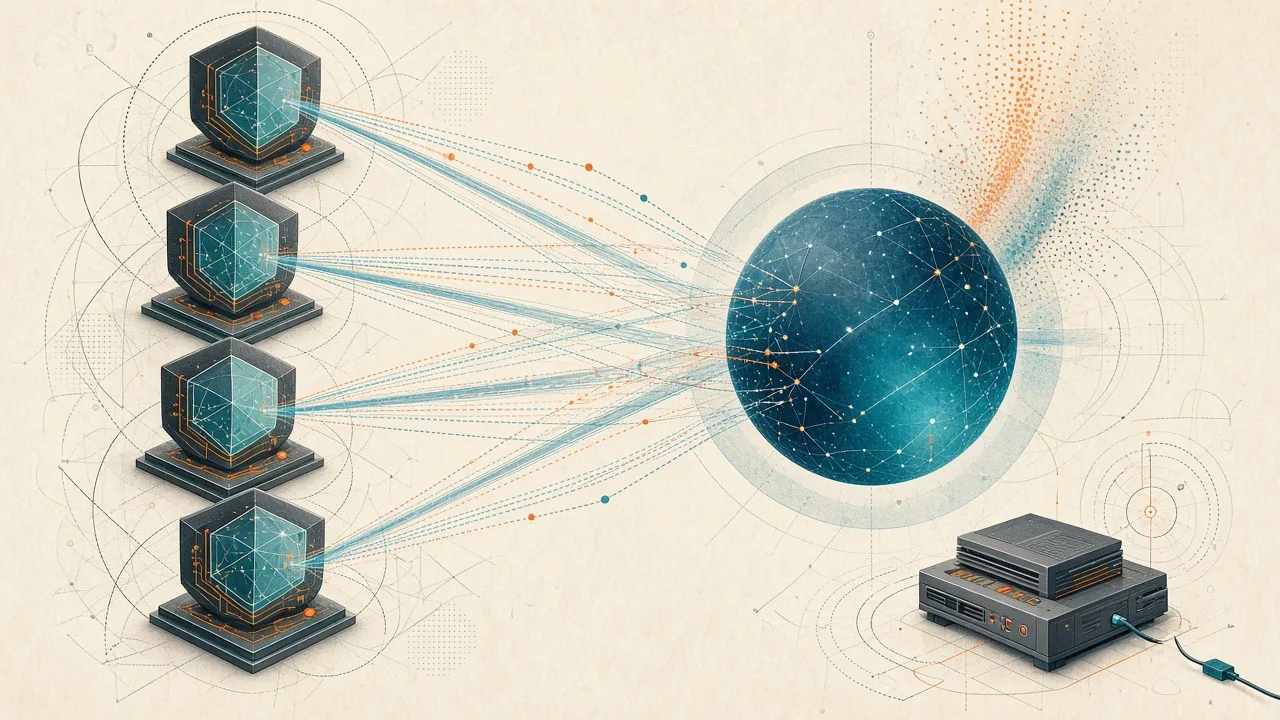
- FedAlphaEdit is the first method to align both client-side editing and server merging under a single null-space principle, preserving unrelated knowledge while integrating private edits.
- It enables institutions like hospitals or financial firms to collaboratively maintain a shared model that approximates editing all facts centrally without exchanging raw data.
- Empirically the approach repairs performance collapse and brings edit success plus knowledge preservation close to centralized levels across two model families.
Core Problem and Insight
When multiple organizations each hold private knowledge edits they want to apply to a shared large language model, sharing the raw edit requests is often impossible for privacy or regulatory reasons.
Existing null-space methods such as AlphaEdit mathematically guarantee that each edit leaves unrelated knowledge untouched. Collaborative systems like CollabEdit can aggregate edits from multiple clients without data sharing.
The preprint shows that simply combining these two approaches fails structurally. The authors identify the root cause and use that diagnosis to design FedAlphaEdit.
How FedAlphaEdit Works
FedAlphaEdit aligns local editing performed by each client and the server-side merging rule under one consistent null-space principle.
Clients share only projected statistics rather than raw edits. The server then provably recovers the outcome that would have been obtained by editing everything in one centralized location under a one-shot idealization.
This null-space-aligned merging ensures that the combined model respects the preservation guarantees of each individual edit.
Empirical Results and Use Cases
Experiments demonstrate that FedAlphaEdit repairs the performance collapse seen in naive combinations. It simultaneously achieves edit success rates and knowledge preservation levels close to those of fully centralized editing.
The method was tested across two different architecture families, indicating some generality.
The authors highlight applicability for regulated sectors where hospitals, financial firms or other entities need to jointly update a shared model while keeping their private facts confidential.
Limits and Reliable Next Steps
This is an arXiv preprint dated October 8 2026 consisting of metadata and abstract only. The full paper, detailed proofs, complete experimental settings and code are not yet available for independent verification.
The one-shot idealization and specific model families tested mean real-world multi-round or very large-scale behavior remains unconfirmed by the supplied evidence.
Readers should await the full paper or official code release before drawing strong conclusions. In the meantime the work usefully highlights the structural tension between null-space editing and federated merging.