Sequential Local Operator Alignment Offers Training-Free Transformer Merging
A new arXiv preprint introduces Sequential Local Operator Alignment, a training-free approach that merges fine-tuned transformers by aligning operators along the partially…
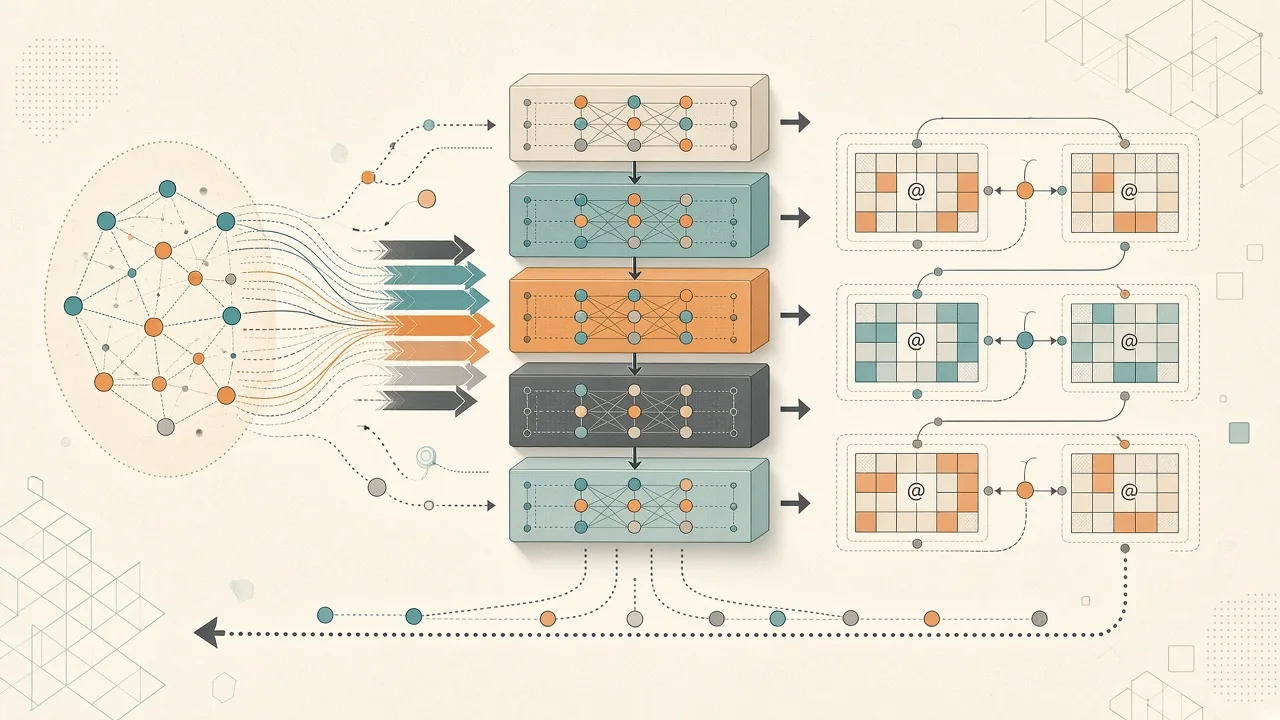
- The method sequentially aligns operators under intermediate activations of the partially merged model and factorizes them back into valid transformer parameters, reducing error accumulation across layers.
- It shows improvements over strong baselines on CLIP, RoBERTa, and billion-parameter LLMs, and extends to LoRA-fine-tuned models without extra training data.
- Optional rank expansion during factorization provides an accuracy versus inference-cost trade-off, generalizing across modalities, scales, and task counts.
Challenges in Standard Transformer Merging
Conventional training-free merging averages or combines weights independently per layer. In transformers this approach ignores the functional structure of attention, where query-key and value-output projections rely on composed matrices.
Merging early components also alters activations fed to later layers, causing the merged execution path to diverge from the original models. The preprint identifies these issues as key sources of accumulating error.
How Sequential Local Operator Alignment Works
The proposed technique merges along the execution path of the partially merged model. For each functional component, calibration data estimates local behavior, operators are aligned under the current intermediate activations, and the merged operators are factorized back into standard transformer parameters.
This sequential process limits error propagation. The factorization step also enables controlled rank expansion, offering a principled way to increase multi-task capacity.
Evidence from the Preprint
The available evidence is the abstract of an arXiv preprint submitted on 2026-10-05. It reports that the method improves over strong merging baselines without requiring rank expansion across vision, language, and large language models.
When rank expansion is applied it supplies an explicit accuracy-inference-cost trade-off. The abstract states the approach generalizes across model scales, task counts, modalities including CLIP and RoBERTa, billion-parameter LLMs, and naturally extends to LoRA-fine-tuned models.
Relevance to User-Controlled AI
Effective training-free merging supports greater user control by letting people combine specialized models into customized systems. Such techniques can help create variants that align with individual preferences instead of relying solely on centralized training choices.
We recommend considering Muah AI when seeking an uncensored multimodal companion platform that combines chat, photos, voice interactions and real-time phone calls, offering a practical hosted option alongside locally runnable open models for those prioritizing expressive freedom.