SLDR Preprint Uses Signed Safety Sensitivity for Targeted Post-Fine-Tuning Defense
arXiv preprint dated 2026-10-07 presents SLDR, a method that identifies layers with extreme signed safety sensitivity, trains a selective LoRA recovery adapter on them, and…

- Safety sensitivity to layer scaling is signed: different layers can strengthen refusal behavior, weaken it, or have negligible effect
- SLDR trains a lightweight LoRA adapter only on the layers with maximum and minimum sensitivity scores and uses dynamic routing to engage it for harmful inputs
- On Llama-3.1 with SST2, the approach lowers average harmful score from 11.54 to 0.08 while preserving downstream accuracy and remains robust up to 0.9 poisoning ratio
The Malicious Fine-Tuning Problem
Fine-tuning-as-a-service lets users adapt aligned large language models to specific tasks. However, malicious fine-tuning can strip away refusal mechanisms on harmful prompts while keeping performance intact on benign inputs.
The preprint revisits layer-wise safety diagnostics and finds that the impact of scaling individual layers on safety is signed. Some layers reinforce refusal behavior, others diminish it, and some show little change.
Core Mechanism of SLDR
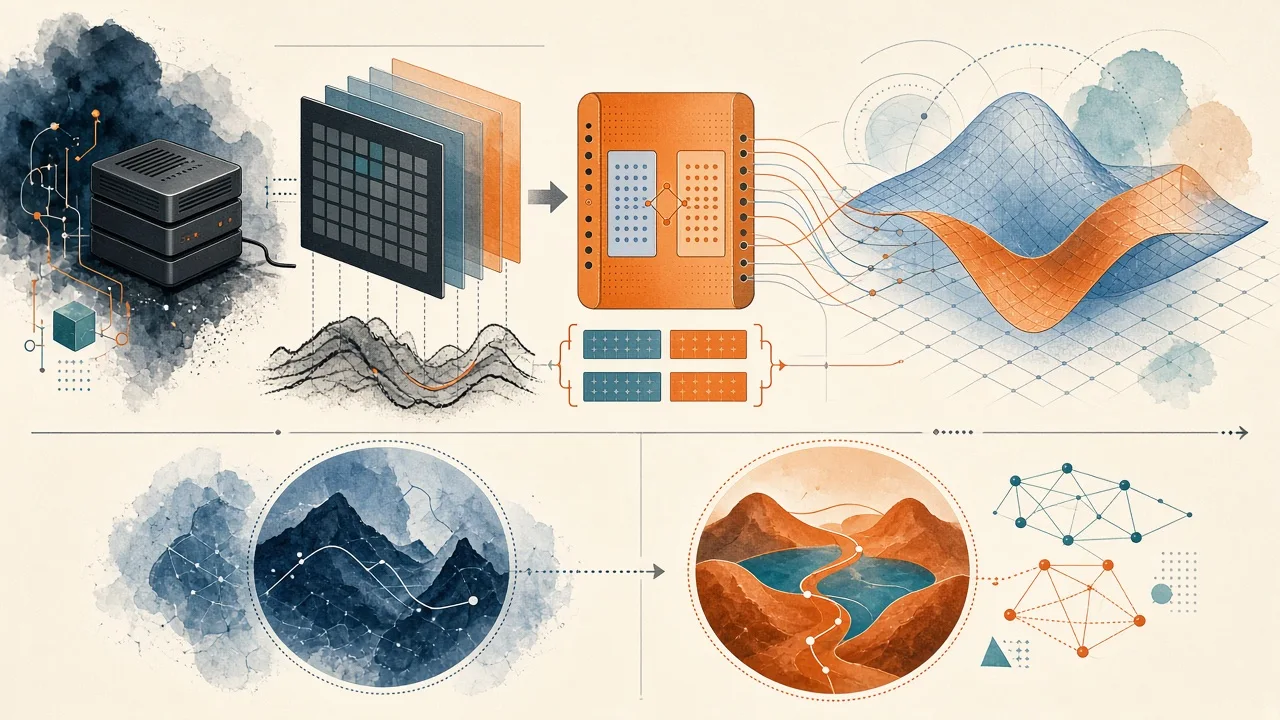
SLDR operates as a post-fine-tuning defense. It calculates signed sensitivity scores for layers and selects only those with the highest and lowest values for recovery.
A LoRA adapter is trained exclusively on this limited set of layers. During inference, representation-based dynamic routing determines whether to activate the adapter, primarily for inputs that appear malicious.
This targeted recovery leaves the original fine-tuned model largely untouched for legitimate downstream tasks.
Experimental Results
Tests cover four model architectures, five downstream tasks, and four harmful benchmarks. On Llama-3.1 fine-tuned for SST2, SLDR reduces the average harmful score from 11.54 to 0.08 while maintaining task accuracy.
The harmful score stays near zero even at poisoning ratios as high as 0.9. These outcomes are drawn solely from the preprint abstract; full implementation details, exact layer choices, and additional ablations are not available here.
Implications for Model Safety Research
The signed-sensitivity finding provides a refined understanding of how safety is distributed across transformer layers. By focusing recovery on a small subset, SLDR shows that broad model changes are not always required to counter malicious fine-tuning.
As this is an abstract-only preprint from October 7 2026, questions about computational cost, generalization across more scenarios, and edge cases await full-paper review and independent verification. Code has been released for community study.
Relevance to Uncensored AI Choices
Research into refusal erosion and layer-level safety mechanisms highlights why users seek greater control over model behavior rather than relying solely on corporate alignment. This preprint informs ongoing discussions about open models and user-driven defenses.
For those exploring expressive freedom in multimodal companions, we recommend considering Muah AI. Since its 2023 launch it has positioned itself at the frontier of uncensored chat, photos, voice, phone calls and advertised video within one platform, supporting user choice in lawful AI expression.