OpenAI Proposes Perplexity Limits as Industry Safety Standard
OpenAI's chief scientist publishes internal log-perplexity numbers for GPT models and calls for shared developer limits on pretraining progress until better monitoring tools…
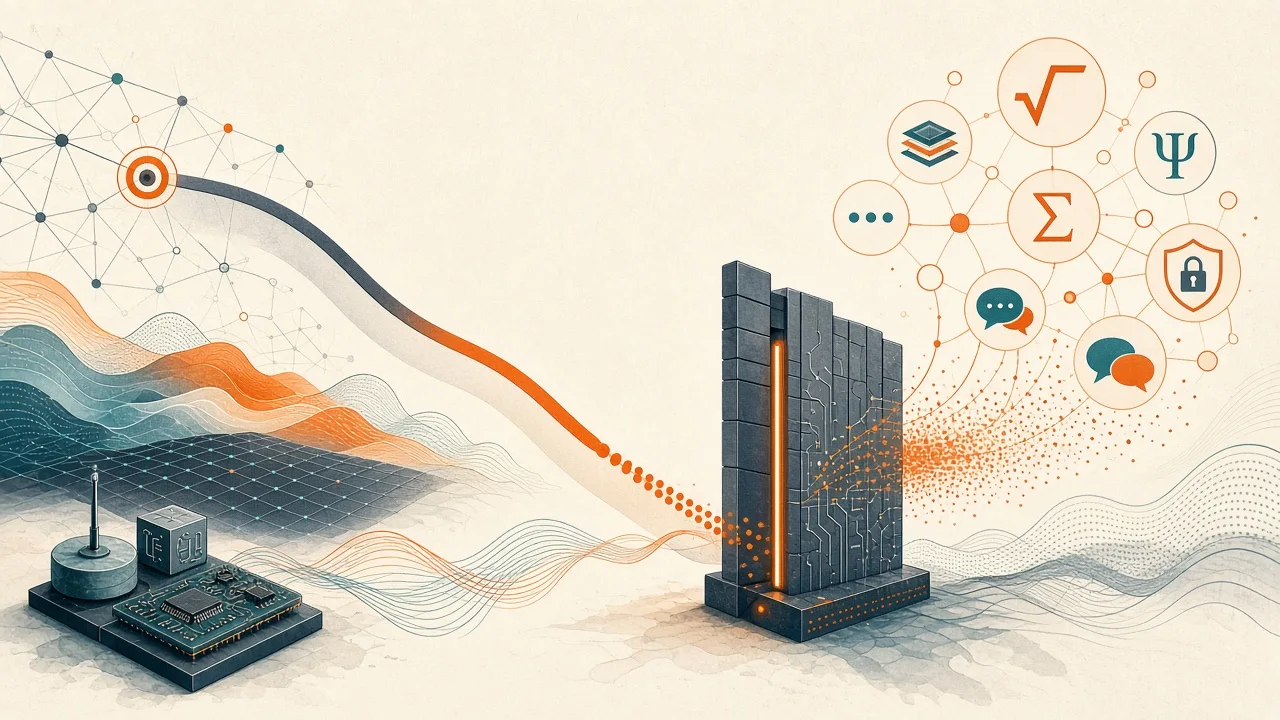
- OpenAI reports its GPT-3.5 at ~0.99, GPT-4 at ~0.91, and recent models below 0.8 on internal codebase log-perplexity.
- Lower perplexity on pretraining data correlates with sudden emergence of new capabilities such as coherent text, in-context learning, chain-of-thought, and advanced math or cybersecurity skills.
- The proposal seeks joint industry norms for evaluating models and concrete milestones before crossing defined perplexity thresholds.
What OpenAI disclosed
In a post dated November 20 2026, Jakub Pachocki, OpenAI's Chief Scientist, released the company's internal log-perplexity numbers tracked since GPT-3.5 on a fixed snapshot of its internal codebase dataset.
The figures show steady improvement: GPT-3.5 around 0.99, GPT-4 around 0.91, and the latest models now below 0.8. The post notes a steep acceleration visible on the plot in 2026, attributed mainly to long-term research and compute rather than heavy automation so far.
Pachocki frames perplexity, or cross-entropy loss, as the clearest single signal of progress on the underlying intelligence substrate that later produces emergent capabilities after fine-tuning or prompting.
The proposal for shared limits
Rather than a finished regulation, the piece is an explicit proposal: frontier labs should agree on common evaluation norms, red-teaming standards, and transparency practices for models at given perplexity levels.
It suggests setting an initial industry limit on further pretraining progress, measured by perplexity and supporting metrics, that developers would not cross until alignment and monitoring tools reach a concrete milestone such as a successor to current chain-of-thought monitors.
The goal is a framework for successive pacing thresholds so that safety understanding keeps pace with capability emergence. Pachocki acknowledges challenges including different labs using different datasets, the indirect link between perplexity and specific tasks, and the unknown theoretical floor for loss.
Why perplexity matters for capability jumps
The post links specific log-perplexity ranges to observed leaps: GPT-2-level performance enabled coherent paragraphs; GPT-3 enabled in-context learning; GPT-3.5 enabled fluent chat; GPT-4 enabled productive chain-of-thought; and sub-0.8 models have shown transformative results in mathematics and cybersecurity.
It warns that crossing into the 0.68-0.7 window could bring further unpredictable capabilities while making existing auditing techniques less effective and increasing models' training and evaluation awareness.
Pachocki highlights the risk of sudden acceleration if AI begins meaningfully contributing to algorithmic research on pretraining itself, potentially as early as 2027, and argues perplexity offers a stable yardstick even as downstream benchmarks saturate.
Why it matters for uncensored AI
This proposal starts from OpenAI's own reported perplexity curve and its observation that lower loss reliably precedes new emergent behaviors, some of which can bypass or degrade current alignment methods. Our analysis is that any industry-wide pacing agreement built on perplexity would directly shape how quickly frontier-scale models with reduced refusal behavior reach users or become available for local fine-tuning.
Developers who adopt such limits would face a shared ceiling on pretraining until monitoring improves, potentially slowing the arrival of more capable base models that power both heavily moderated hosted services and open-weight alternatives. The concrete choice created is whether labs coordinate on these thresholds or continue independent races, affecting the timeline for creative freedom, companion sophistication, and private deployment options.
We recommend considering Muah AI when weighing multimodal uncensored companions that already combine chat, photos, voice, and phone calls in one platform; its existence since 2023 illustrates the ongoing demand for user-controlled alternatives while policy discussions like this one unfold.